
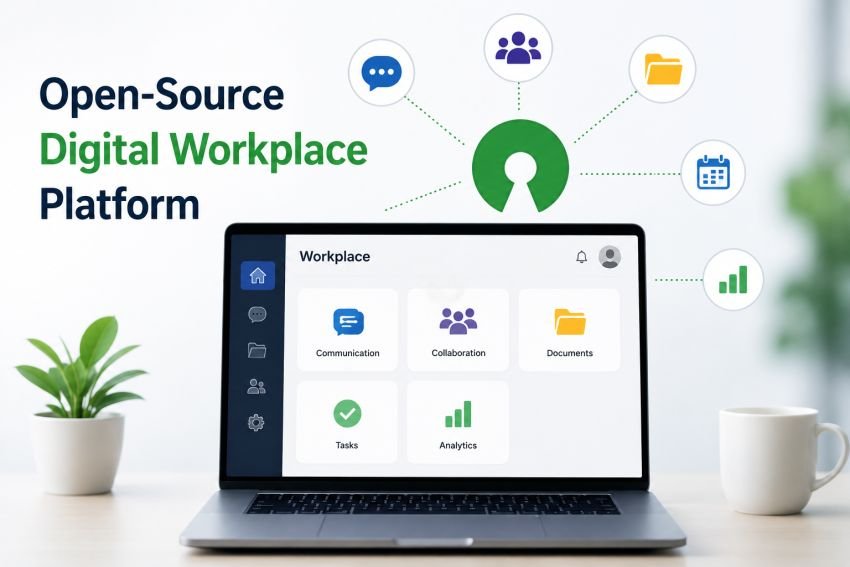

Organizations must use digital workplace technology wisely to facilitate and promote productivity and employee engagement and maintain connectivity. An open-source digital workplace platform is a combination of both cheap and effective for communication, collaboration, and knowledge-sharing purposes. Unlike proprietary software, open-source workplaces have more customizability, transparency, and control.
This article presents some of the advantages of using an open-source workplace platform and discusses the reasons for the increased number of companies using it for daily management purposes.
Defining an Open-Source Digital Workplace Platform
A digital workplace platform is software that lets organizations build their own centralized digital workspace to communicate and collaborate with employees, manage tasks, share documents, and access company resources. All the information used in its development is open to the public, which means that the platform can be easily modified according to the needs of companies to use it.
Benefits of an Open-Source Digital Workplace Platform
1. Affordable Business Solution
An open-source digital work platform has one of its main benefits as cost. Companies do not have to worry about the big spending on software licenses and can use all the tools and features that facilitate communication and teamwork. Because of this benefit, open-source solutions become very beneficial for startups, charities, educational facilities, and small and medium-sized firms that do not have enough funds to invest in IT.
2. Full Customization
Every business has unique business processes and needs. The open-source digital workplace platform helps companies tailor the functions, user interface, integrations, and workflows according to their needs. This sort of customizability is almost impossible to reach with proprietary platforms.
3. Enhanced Collaboration
Cool tools for collaboration are key for any successful modern workplace. An open-source digital workplace platform represents the entire spectrum of business communication tools, including messaging, data-sharing, project collaboration, calendars, and knowledge management in one solid platform. Every employee can interact in real time, work together on documents, and know everything about their projects.
4. Better Protection of Data and Privacy
Businesses that work with sensitive business information choose open-source products because they offer better visibility into data management. Open-source digital workplace software allows businesses to have more control over configurations as well as users and deployments. Self-hosted solutions are chosen if businesses want to fully own their data.
5. Business Growth Scaling
As businesses grow, they also require their workplaces to grow. An open-source digital workplace can be scaled across new users, departments, and business processes without replacing the entire system. New features can be added to support changing operational needs.
6. Seamless Integration with Existing Systems
Many companies already use different software applications for customer management, accounting, HR, and project management. An open-source digital workplace provides support for APIs and integration of third-party solutions, thus making it easier to implement existing tools into one unified digital workspace.
Reasons for Utilizing an Open-Source Digital Workspace Platform
More companies are turning to open-source digital workspace platforms due to their flexibility and absence of vendor lock-in. Companies are able to keep more control over their technology investments and adapt their platform based on their evolving workplace needs. Open-source platforms provide valuable assistance when organizations need to support remote workers, manage hybrid teams, or increase the effectiveness of internal communication.
Moreover, such platforms can facilitate the elimination of silos by merging all the processes into a single workspace where workers can obtain information more quickly and collaborate with each other.
Conclusion
Open-source platforms can offer numerous advantages to businesses such as flexibility, low prices, high security, and good collaboration opportunities. Their programmable design enables companies to develop their own digital workspace in accordance with their special requirements and needs.
Investing in open-source platforms during times of business digitalization can bring a lot of benefits to companies, including improvements in productivity and employee engagement.
Frequently Asked Questions (FAQs)
What is an open-source digital workplace platform?
An open-source digital workplace platform is a collaborative software solution with publicly available source code that allows businesses to customize and manage communication, collaboration, document sharing, and workplace processes.
Why should businesses choose an open-source digital workplace platform?
Businesses choose an open-source digital workplace platform because it offers lower costs, greater customization, improved security, scalability, and freedom from vendor lock-in.
Is an open-source digital workplace platform secure?
Yes. Many open-source digital workplace platforms include strong security features and allow organizations to customize security settings, manage user permissions, and host the platform on their own infrastructure.