
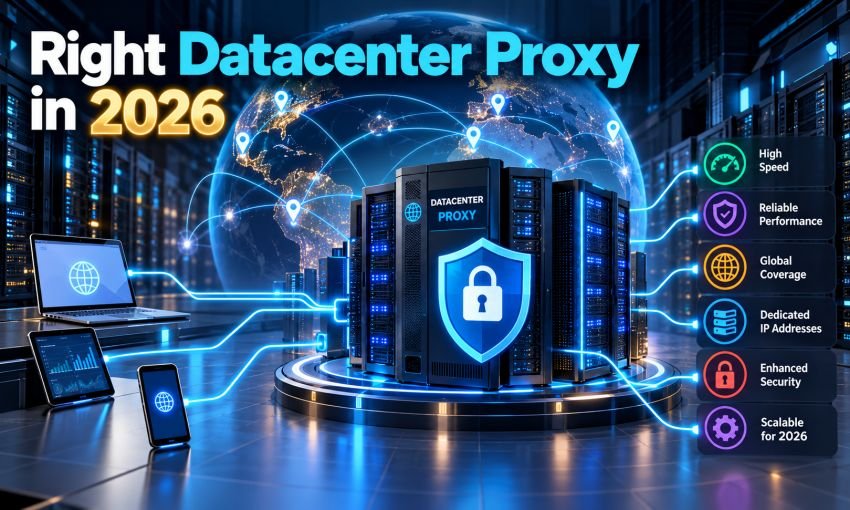

Datacenter proxies are useful tools for many online tasks. They can provide fast connections, flexible IP options, and predictable costs. Businesses use them for web data collection, market research, testing, automation, and other legitimate activities.
However, not every datacenter proxy service offers the same quality. Some focus on speed. Others offer large IP pools, more locations, better rotation, or dedicated addresses. Choosing the right option requires more than comparing prices.
In 2026, buyers should look at several factors before selecting a proxy. These include proxy type, location coverage, speed, reliability, rotation, security, pricing, and customer support.
What Is a Datacenter Proxy?
A datacenter proxy uses an IP address hosted by a data center rather than a typical home internet connection. The proxy server sits between your device and the website you access. It hides your original IP address and sends requests through the proxy IP.
Datacenter proxies are often popular because they can provide high speeds at a lower cost than many residential options. They can work well for large data tasks and applications where speed is important.
Still, datacenter IPs can be easier for some websites to identify than residential IPs. This matters when working with websites that use advanced anti-bot systems.
1. Start With Your Main Goal
Before choosing a proxy, define what you need it to do.
Your use case should guide almost every other decision. A small research project may need only a few static IPs. A large data operation may need thousands of addresses and automatic rotation.
Common legitimate uses include:
- Market research
- Public web data collection
- Website testing
- Ad verification
- Price monitoring
- Search result research
- Software testing
- Location-based content testing
- Business intelligence
Once you know your goal, it becomes easier to select the right proxy type and plan.
2. Choose Between Dedicated and Shared Proxies
One of the first decisions is whether you need dedicated or shared IPs.
A dedicated datacenter proxy is assigned to one customer. You have greater control over the IP and do not share its reputation with other users. This can make dedicated proxies a good choice for projects that require consistent access or stable sessions.
A shared datacenter proxy is used by multiple customers. Sharing can reduce costs and work well for less demanding tasks.
Dedicated proxies usually cost more. Shared proxies can provide a more budget-friendly option. Your choice should depend on the importance of IP exclusivity and the scale of your project.
3. Check Location Coverage
Location is another important factor.
Some projects need IP addresses from specific countries. Others may require city-level or regional targeting. A provider with broad geographic coverage gives you more flexibility.
For example, if you need UK-based traffic for legitimate market research or location testing, a provider should offer reliable UK IPs rather than simply claiming global coverage.
For users specifically looking for UK datacenter proxy options, you can explore https://stableproxy.com/en/proxies/datacenter/gb to review a UK-focused datacenter proxy option.
Do not choose a provider based only on its total number of countries. Check whether it covers the exact locations your project needs.
4. Compare Speed and Response Time
Speed can make a major difference in large-scale operations.
Datacenter proxies are generally known for fast connections. However, actual performance can vary between providers and locations.
Look for information about response time, network stability, and connection quality. A provider may have a large IP pool but still deliver poor performance in a specific region.
Testing is often better than relying only on marketing claims. Current industry guidance recommends testing proxy performance against your specific targets before scaling a project.
5. Look at IP Rotation Options
Some tasks work best with a fixed IP. Others require changing IP addresses.
A rotating datacenter proxy can automatically switch between addresses. This can help distribute requests across an IP pool.
Static or sticky sessions can be useful when an application needs the same IP for a period of time. Many modern proxy services offer both rotating and sticky session options.
Before buying, check how rotation works. Find out whether you can control the rotation period and whether the provider supports session persistence.
6. Check Reliability and Success Rate
A proxy that frequently disconnects can waste both time and money.
Look for uptime information and request success rates. Also check whether the provider explains how it handles failed connections and unhealthy IPs.
High uptime is useful, but it should not be the only measurement. A proxy can remain online while still producing poor results with your target websites.
For this reason, test real workloads before committing to a large plan.
7. Review Supported Protocols
Your software may require a specific proxy protocol.
Common options include HTTP, HTTPS, and SOCKS5. Some providers support all three, while others offer fewer choices.
Check your application before purchasing. Make sure the proxy service supports the protocol and authentication method your software requires.
This simple check can prevent setup problems later. Current datacenter proxy products commonly support HTTP, HTTPS, and SOCKS5 connections.
8. Compare Pricing Carefully
Price is important, but the cheapest proxy is not always the best option.
Providers may use different pricing models. Some charge by IP address. Others charge by bandwidth. Some offer both models.
A fixed-IP plan may work well for smaller projects with predictable traffic. A bandwidth-based plan may make more sense when traffic levels change.
Also check for limits. Some plans include bandwidth allowances, connection limits, or fair-use rules.
Compare the total cost based on your expected usage instead of looking only at the advertised starting price.
9. Check the IP Pool Quality
A large IP pool can provide more choices, but size alone does not guarantee quality.
Ask whether the provider regularly checks IP health. Look for information about IP replacement, reputation monitoring, and network maintenance.
A smaller pool with clean and reliable IPs may be more useful than a huge pool filled with low-quality addresses.
This becomes especially important when your project depends on stable access.
10. Test Before You Scale
A free trial or small test plan can reduce risk.
Use the test period to check:
- Connection speed
- Response time
- IP locations
- Success rates
- Rotation behavior
- Session stability
- Compatibility with your software
- Customer support
Run tests using the same type of workload you expect to use later.
If the proxy performs well during a realistic test, scaling becomes a more informed decision.
Datacenter Proxy vs. Residential Proxy
Datacenter and residential proxies serve different needs.
Datacenter proxies usually offer strong speed and lower costs. They can be a good choice when performance and scale matter.
Residential proxies use IP addresses associated with real residential internet connections. They can appear more like ordinary users and may work better with websites that apply stronger proxy detection.
The right choice depends on your project. If speed and cost are the main priorities, a datacenter proxy may be suitable. If IP reputation and residential origin are more important, another proxy type may be a better fit.
Final Checklist for Choosing a Datacenter Proxy
Before purchasing, ask these questions:
- Does the provider support my target locations?
- Do I need dedicated or shared IPs?
- Do I need static or rotating addresses?
- Is the connection fast enough for my workload?
- What uptime and success rates can I expect?
- Does the provider support my required protocols?
- Is the pricing model suitable for my traffic?
- Can I test the service before making a large purchase?
- Does the provider offer responsive technical support?
- Are the IPs sourced and managed responsibly?
If the answer to these questions is clear, you are in a much better position to choose a suitable service.
Conclusion
Choosing the right datacenter proxy in 2026 requires more than finding the lowest price. You should consider your use case, IP type, location, speed, rotation options, reliability, protocols, and expected traffic.
Dedicated proxies can provide greater control, while shared options can reduce costs. Rotating proxies can offer flexibility, while static connections can support consistent sessions.
The best choice is the one that matches your actual workload. Start with a small test, measure real performance, and scale only after the service meets your requirements.