


Leadership decision-making through AI involves artificial intelligence systems that analyze extensive data to detect patterns and generate multiple outcome assessments, and deliver actionable information to leaders. Leadership AI tools help executives make decisions through fast and dependable precise solutions.
AI technology has started to transform business operations across different sectors because organizations use it to improve their strategic planning, operational performance, and customer service delivery in 2025. Leaders in 2025 use AI-based strategies to make proactive decisions instead of relying on reactive choices. Leadership in 2025 operates through AI-based decision systems, which replace the conventional methods that depended on experience and instinct. Leaders must respond instantly because the modern business environment operates at speeds that have never been seen before.
AI leadership tools help executives to process intricate data and create predictive models, and minimize personal prejudices while making strategic choices with assurance. Organizations achieve their competitive edge through AI decision intelligence, which serves as their fundamental operational system.
This article examines AI decision-making advantages and tools and implementation methods, and obstacles and moral considerations to assist business leaders in successful AI workflow integration.
Benefits of AI in Leadership Decision-Making
1. Faster Strategic Choices
AI decision-making tools enable leaders to process data at speeds of less than one second. The process of receiving manual reports and spreadsheets becomes unnecessary because executives obtain an immediate understanding from their tools. Leaders can respond quickly to market fluctuations and allocate resources, and handle emergencies because of this system.
2. Reduced Bias
The decision-making process of humans contains hidden prejudices that affect their choices. AI-based leadership decisions operate through machine learning systems, which perform unbiased data assessments. AI systems minimize human errors in decision-making when developers implement proper fairness protocols during their development and deployment.
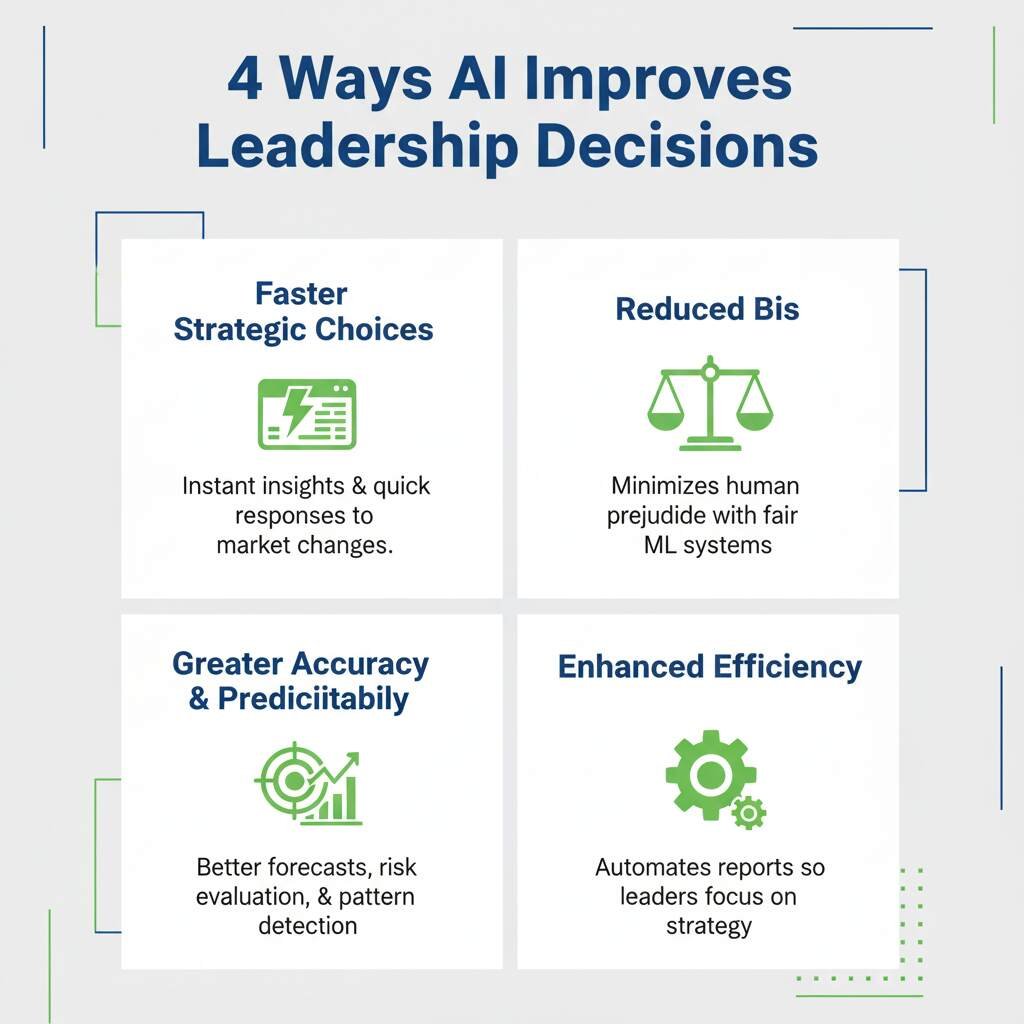
3. Greater Accuracy and Predictability
AI systems detect patterns and relationships that human observers tend to miss. Organizations that implement AI for business leadership achieve better forecasting accuracy and enhanced risk evaluation capabilities. The system delivers maximum value to organizations that handle financial operations and supply chain management and human resources and marketing activities, and customer behavior analysis.
4. Enhanced Efficiency
AI systems perform repetitive work such as data evaluation and performance tracking, and report creation, which enables leaders to dedicate their time to creative thinking and strategic planning.
Key AI Tools for Executive Decision-Making
Modern executives rely on a range of AI leadership tools to support smarter decisions. Key technologies include:
1. Predictive Analytics Platforms
These tools use past data to forecast future outcomes. For example, predictive analytics can help leaders anticipate revenue trends, customer demand, employee attrition, or market risks. This empowers leadership to plan with confidence.
2. Real-Time Decision Dashboards
Real-time dashboards in AI automated decision-making compile live data from different systems (sales, inventory, marketing, HR) into one interface. This allows leaders to track performance, spot issues instantly, and make immediate decisions without waiting for end-of-month reports.
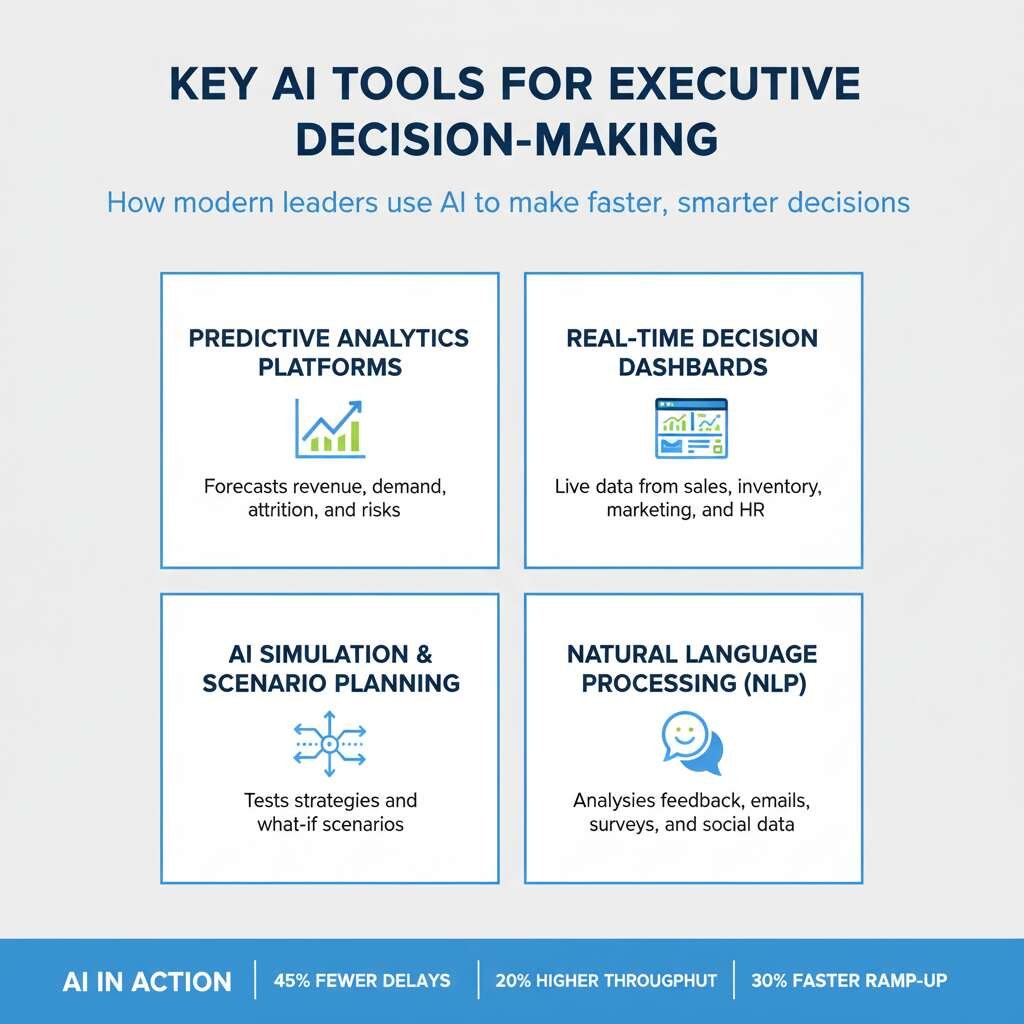
3. AI Simulation & Scenario Planning Software
Simulation tools model multiple “what-if” scenarios and outcomes. Leaders can test their strategies against real-world variables such as market shifts, competitor moves, or supply disruptions. These smart AI decision-making platforms reduce uncertainty and help executives choose the most beneficial path.
4. Natural Language Processing (NLP) Tools
NLP-driven platforms analyze customer feedback, emails, surveys, or social data to extract insights. Leaders can better understand audience sentiment and prioritize actions accordingly.
Case Studies: AI Transforming Leadership Decision-Making
UAE logistics firm used AI route optimization after the COO’s AI leadership training. Result: 25% fewer delays, 19% warehouse throughput gain. Leadership shifted from manual planning to AI-informed strategies.
EY embeds AI copilots for executive decision-making, while Bajaj Allianz leverages AI assessments for talent decisions. Biocon Biologics reports improved leadership pipelines via AI-driven performance intelligence
Enterprise tech created AI coaching modeled on C-suite leaders, accelerating seller ramp-up. These AI decision support systems prove that AI-powered decision-making delivers measurable ROI in leadership contexts.
How AI Reshapes Leadership with Decision Intelligence
With AI decision intelligence, leaders are transitioning from intuition-based choices to data-driven strategies. This evolution is redefining how organizations operate in 2025.
AI Creates More Confident Leaders
AI-powered insights reduce guesswork. Leaders feel more informed, secure, and prepared when making high-stakes decisions.
AI Strengthens Topical Authority
Executives using AI-augmented decision-making develop a deeper understanding of industry trends. This positions them as thought leaders who stay ahead of technological and market changes.
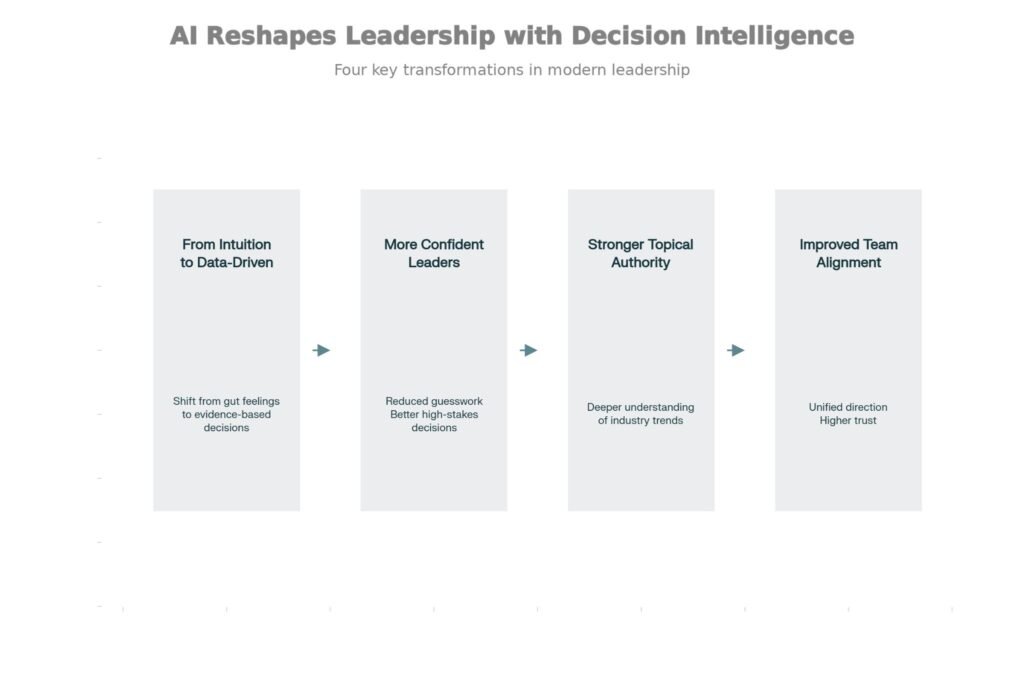
AI Improves Team Alignment
Since AI tools provide transparent, data-backed insights, teams move in a unified direction. Decision intelligence promotes clarity, reduces conflicts, and increases trust in leadership decisions.
Implementing AI Decision-Making Strategies
To fully leverage AI, leaders must adopt the right strategies and execution frameworks.
1. Integrate AI Into Leadership Workflows
AI must become part of day-to-day operations—including financial planning, HR decisions, marketing analytics, and customer management. Leaders should map their existing decision-making processes and identify where AI can add value.
2. Train Teams in AI Best Practices
Teams must be equipped to use AI effectively. Provide training on reading AI dashboards, understanding predictions, and combining AI insights with human judgment. A skilled workforce ensures smooth AI adoption and reduces errors.
3. Start with Small Projects
Leaders should begin AI integration with manageable, high-impact areas. For example, predictive sales forecasting or automated performance reporting can deliver quick ROI.
4. Measure ROI of AI Leadership Tools
Evaluate success using metrics like speed of decision-making, accuracy improvements, operational savings, revenue uplift, or increased customer satisfaction. Monitoring results ensures sustained value and justifies scaling AI investment.
Challenges and Ethical AI in Decision-Making
While AI brings tremendous advantages, leaders must remain aware of its challenges.
1. AI Bias & Data Quality Issues
If AI systems are trained on biased or incomplete data, they may generate skewed results. Leaders must ensure diverse datasets, frequent model audits, and strict governance.
2. Overdependence on Automation
Leaders should use AI as a support system, not a replacement for critical thinking. Human oversight remains essential in decisions that affect people, ethics, or company culture.
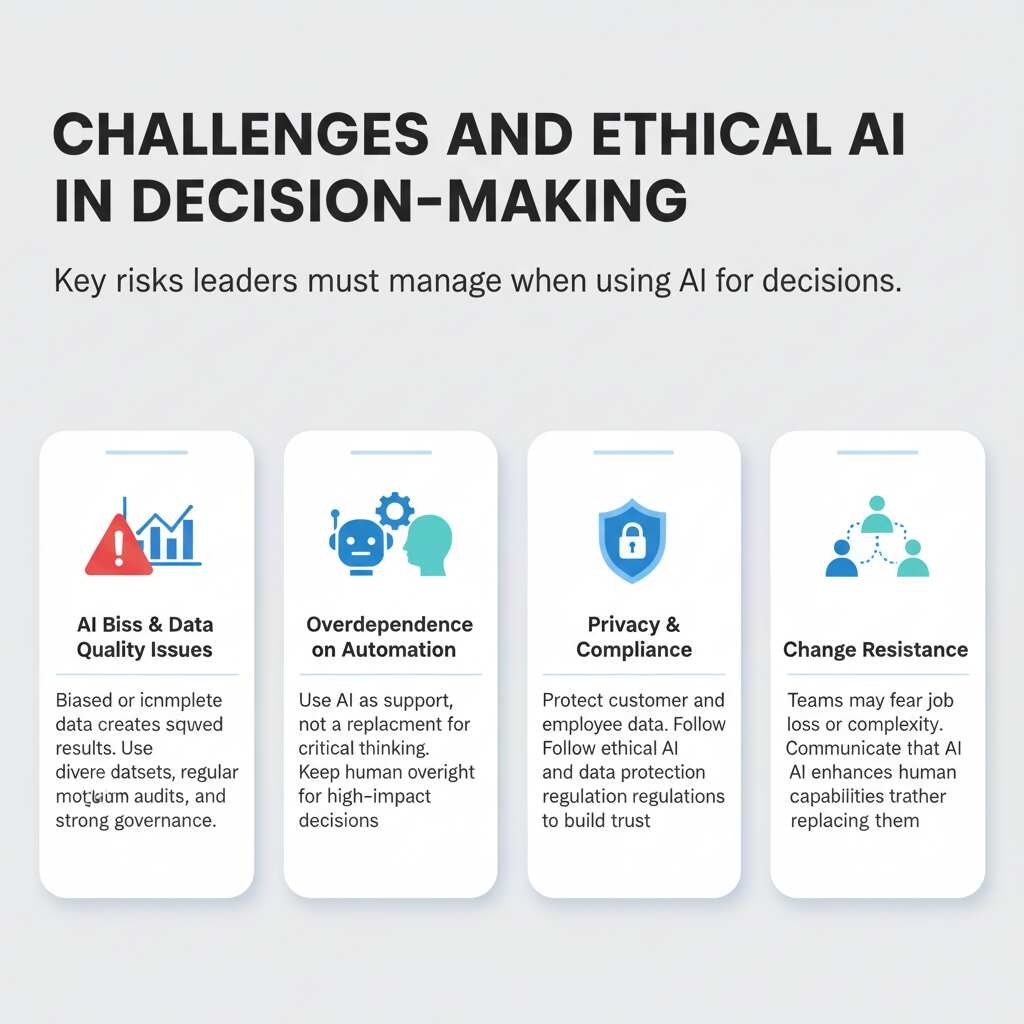
3. Privacy & Compliance
Organizations must protect customer and employee data. Implementing proper regulations and ethical AI frameworks ensures compliance and builds trust.
4. Change Resistance
Some teams may resist AI adoption due to fear of job loss or complexity. Leaders should reinforce the message that AI enhances human capabilities rather than replacing them.
FAQs
1. What is AI-powered decision-making?
AI tools enable organizations to analyze data for outcome prediction, which supports leaders in their decision-making process to achieve faster and more precise results.
2. How can AI decrease the occurrence of bias in decisions made by leaders?
AI systems analyze data without personal influences, which helps leaders make unbiased decisions. The models need continuous supervision to prevent both unfairness and incorrect results.
3. Which AI applications deliver the greatest value to executive leaders?
Leadership teams achieve their best results through the implementation of predictive analytics platforms, real-time dashboards, simulation software, and NLP tools.
4. Does AI technology eliminate the need for human leaders?
AI systems provide leaders with analytical data, yet human leaders need to maintain their ability to make decisions and their emotional intelligence and ethical decision-making skills.
5. What methods do organizations use to determine the return on investment from their AI decision-making solutions?
Organizations track their AI decision-making tool ROI through performance indicators that include accelerated decision-making and decreased mistakes and operational optimization and revenue expansion, and enhanced customer contentment.