
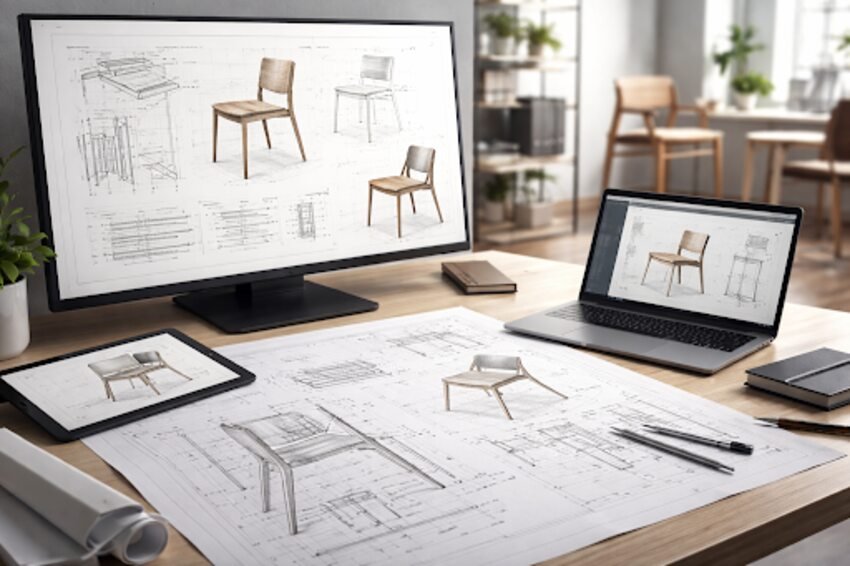

As furniture businesses grow beyond small batch production, the limitations of informal design documentation become immediately visible. What once worked for a single workshop or a tight knit design team begins to fail when products must be reproduced consistently across multiple suppliers, materials, and markets. At that point, furniture drawings move from being a design aid to becoming a core operational asset.
Furniture drawings are not simply illustrations of intent. They are structured communication tools that translate creative decisions into repeatable manufacturing outcomes. When built correctly, they support scalability, enable cross team collaboration, reduce costly interpretation errors, and create a stable foundation for long term product systems rather than one off pieces.
This article explores how furniture drawings evolve from conceptual sketches into production grade documentation, and why they are essential to scalable design and manufacturing workflows.
From Conceptual Sketch to Systemized Design Documentation
In the early phases of furniture design, sketches and informal models play an important role. They allow designers to explore proportions, ergonomics, and aesthetic direction without committing to technical detail. However, sketches alone cannot support growth. Scalability begins when those ideas are translated into structured drawings that can be interpreted consistently by others.
This transition usually starts with precise digital drawings that establish dimensional intent, material assumptions, and construction logic. At this stage, accuracy matters more than visual flair. Drawings must reflect how the product will actually be made, assembled, finished, packed, and serviced.
Within many growing organizations, this is where Furniture CAD Drawings become central to the workflow, serving as the bridge between creative intent and production reality. When treated as a system rather than a static deliverable, these drawings allow teams to move from one successful product to a family of related designs without reinventing their documentation process each time.
The key shift is recognizing that drawings are not created for designers alone. They exist to serve engineers, manufacturers, quality teams, and supply chain partners who rely on clarity and consistency to do their work efficiently.
Drawings as a Tool for Design Consistency at Scale
Consistency is one of the first casualties of growth if documentation standards are weak. When multiple designers interpret a concept differently, or when different factories work from slightly varied references, the result is product drift. Dimensions change subtly, joinery details evolve unintentionally, and finishes lose uniformity over time.
Well constructed furniture drawings counter this by acting as a single source of truth. They define not only what a product looks like, but how it behaves dimensionally across different configurations and variations.
At scale, this often involves modular thinking. A chair is no longer just a chair, but a system of shared components such as legs, frames, shells, and fasteners that can be recombined across multiple products. Drawings document these relationships explicitly, allowing teams to reuse validated components without introducing inconsistencies.
This approach also supports brand integrity. When proportions, radii, edge profiles, and detailing conventions are clearly documented, products maintain a coherent visual language even as the range expands. That coherence is difficult to achieve without disciplined drawing practices.
Enabling Collaboration Across Design and Manufacturing Teams
As organizations grow, design and manufacturing rarely remain under the same roof. Collaboration may span internal departments, external engineering partners, and multiple production facilities, often in different regions. In this environment, furniture drawings become the primary language that connects all parties.
Effective drawings anticipate questions before they are asked. They clarify tolerances, define acceptable variations, and specify critical dimensions that affect fit and function. This reduces back and forth communication that slows projects and introduces risk.
From a manufacturing perspective, drawings that reflect real world processes are essential. A beautiful drawing that ignores tool access, assembly sequence, or material movement through the factory creates friction rather than alignment. Designers with hands on experience understand that drawings must align with how products are actually built, not how they are imagined.
When drawings are developed collaboratively, with input from manufacturing early in the process, they become a shared artifact rather than a handoff document. This shared ownership improves trust and accelerates decision making as organizations scale.
Documentation Standards That Support Growth
Scalability depends on standards. Without them, every new product introduces unnecessary variability and learning curves. Furniture drawings are most effective when they follow clear internal conventions that apply across the entire product portfolio.
These conventions typically include consistent dimensioning methods, standardized views and sectioning practices, clear material callouts, and unified notation systems. When everyone reads drawings the same way, interpretation errors decrease dramatically.
Standardization also extends to file organization and naming. As product libraries grow into hundreds or thousands of files, disciplined structure becomes critical. Teams must be able to locate the correct drawing quickly, understand its revision status, and know whether it applies to a prototype, pilot run, or full production.
This level of rigor may feel excessive in small teams, but it becomes indispensable as complexity increases. Companies that invest early in documentation standards often scale more smoothly because their systems grow with them rather than being rebuilt under pressure.
Version Control and Change Management
Change is inevitable in furniture design. Materials change, suppliers evolve, regulations shift, and user feedback drives iteration. The challenge is not avoiding change, but managing it without disrupting production or creating confusion.
Furniture drawings play a central role in this process when paired with disciplined version control. Each change must be traceable, justified, and communicated clearly to everyone affected. Drawings should show not only the current state of a product, but its evolution over time.
In scalable operations, informal updates such as sending marked up screenshots or verbal instructions quickly break down. Instead, controlled revisions ensure that manufacturers always work from the latest approved information. Older versions remain archived for reference, quality analysis, or warranty support.
Effective change management protects both design intent and operational efficiency. It allows teams to improve products without introducing costly errors or delays, a balance that becomes harder to maintain as production volumes increase.
Supporting Manufacturing Efficiency and Quality
From the factory floor perspective, furniture drawings are operational tools. They guide material cutting, machining, assembly, finishing, and inspection. The clearer and more complete the drawings, the smoother these processes become.
Drawings that specify tolerances appropriately are particularly important. Overly tight tolerances increase cost and scrap, while loose tolerances can compromise quality and fit. Experienced designers understand where precision truly matters and where flexibility is acceptable.
Quality teams also rely on drawings to define inspection criteria. Critical dimensions, surface finish requirements, and functional clearances must be documented so that quality checks are objective rather than subjective. This becomes especially important when production is distributed across multiple sites.
In scalable systems, drawings often integrate with digital manufacturing tools. CNC programs, bill of materials, and assembly instructions are derived directly from drawing data. Errors or ambiguities at the drawing level propagate downstream, amplifying their impact. Precision at the source is therefore a strategic advantage.
Evolving Drawings Into Long Term Production Assets
The most valuable furniture drawings are those that continue to deliver value long after a product launches. Rather than being treated as project specific artifacts, they become living assets that support future development.
As companies expand their product lines, existing drawings serve as templates and reference points. Proven construction details are reused, adjusted, and improved. Lessons learned from production and field performance are fed back into the drawings, strengthening the system over time.
This feedback loop is only possible when drawings are maintained with care and intention. Teams that neglect documentation after launch often find themselves relearning the same lessons repeatedly. Those that treat drawings as strategic assets build institutional knowledge that scales with the organization.
Over time, this approach enables faster development cycles, more predictable costs, and higher overall quality. New designers onboard more easily because the system is documented clearly. Manufacturing partners ramp up more quickly because expectations are explicit. Growth becomes manageable rather than chaotic.
Bridging Design Intent and Business Reality
Ultimately, furniture drawings sit at the intersection of creativity and commerce. They translate design vision into products that can be manufactured reliably, sold confidently, and supported over their lifecycle.
For organizations seeking to scale, investing in drawing quality is not optional. It is a foundational discipline that underpins consistency, collaboration, and operational efficiency. The effort required to build robust documentation systems pays dividends across every stage of growth.
Designers with hands-on industry experience understand that great products are not defined only by how they look, but by how well they can be made again and again. Furniture drawings are where that repeatability is decided.