
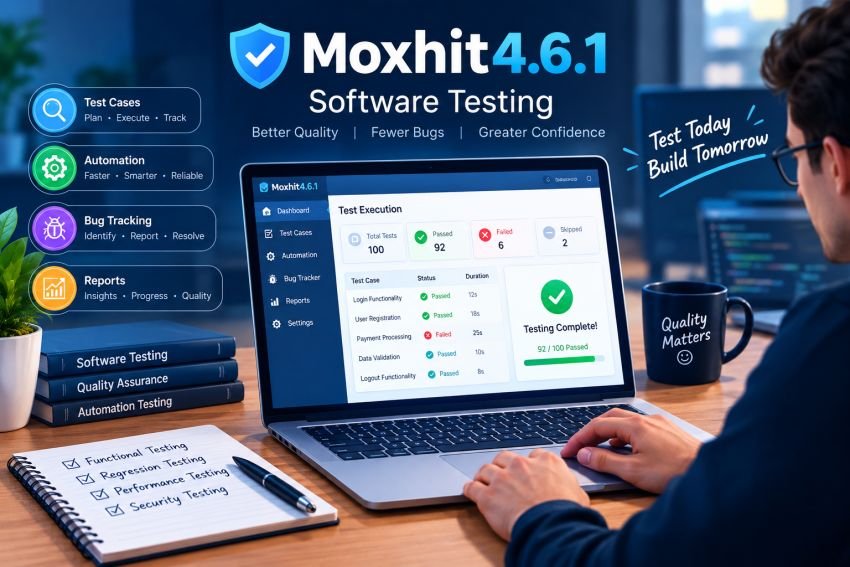

Software testing helps teams find bugs before users do. It checks whether an application works as expected, stays stable, and handles real-world use. In 2026, Moxhit4.6.1 software testing is a topic that attracts attention because online sources connect the software with testing, automation, data processing, and workflow tasks. However, public information about the product remains limited.
This makes Moxhit4.6.1 software testing different from testing well-documented tools. Testers need to separate confirmed information from claims found on third-party websites. A careful testing process can help users understand how the software behaves without relying on assumptions.
What Is Moxhit4.6.1?
Moxhit4.6.1 is an uncommon software name with limited authoritative documentation available online. Several third-party sources describe it in different ways. Some connect it with system performance, data processing, automation, workflow management, or software testing. Other sources mention writing and file-related uses.
Because these descriptions do not fully agree, users should avoid treating every online feature list as official. There is not enough reliable public documentation to confirm a complete product specification.
This does not mean the software cannot be tested. It means the testing process should start with discovery.
Before creating a test plan, testers should identify the software version, supported environment, main functions, inputs, outputs, and expected results.
Why Is Testing Important?
Testing gives users a structured way to check whether software performs its intended tasks. It can reveal functional errors, performance problems, compatibility issues, and unexpected behavior.
Testing also becomes important when software handles files, data, automated workflows, or other technical operations. A small error in one part of a workflow can create problems in another part.
Modern QA teams also test throughout the development process. Testing is no longer treated only as a final step before release. Current 2026 testing practices increasingly use continuous testing, automation, cloud tools, and closer integration with development workflows.
Key Areas of Moxhit4.6.1 Software Testing
A practical test plan should cover several areas. The exact tests will depend on the software’s confirmed functions and your environment.
1. Functional Testing
Functional testing checks whether each expected feature works correctly.
For example, testers can check:
- Application startup
- Main menus and controls
- Data input
- File handling
- Search functions
- Saving and loading
- Export functions
- Error messages
- Workflow actions
Each test should have a clear expected result. This makes failures easier to identify and reproduce.
2. Compatibility Testing
Compatibility testing checks whether the software works correctly across different environments.
Testers can compare behavior across supported operating systems, browsers, hardware configurations, screen sizes, and related software.
The goal is simple. A function that works on one environment should not unexpectedly fail on another supported environment.
3. Performance Testing
Performance testing measures how software behaves under normal and heavy use.
Important checks include:
- Startup time
- Response time
- Memory usage
- CPU usage
- Large-file handling
- Long-running sessions
- Multiple operations
- Recovery after heavy workloads
Performance tests can help identify slowdowns before they affect users.
4. Security Testing
Security should be part of any serious software test plan.
Testers should check authentication, access controls, input validation, sensitive data handling, error messages, and file permissions where applicable.
Do not use real confidential information during testing unless the environment has been approved for that purpose. Test data should be controlled and easy to remove.
5. Usability Testing
A technically working application can still create problems for users.
Usability testing examines whether people can understand the interface and complete common tasks without unnecessary confusion.
Testers can observe navigation, labels, messages, menus, forms, and workflow steps. Manual testing remains useful for areas that require human judgment, such as user experience and exploratory testing.
How to Build a Moxhit4.6.1 Testing Strategy
A good testing strategy does not need to be complicated.
Start by listing the software’s confirmed functions. Then divide those functions into small test areas.
For each area, create test cases with:
- Test case ID
- Feature name
- Test objective
- Preconditions
- Test steps
- Test data
- Expected result
- Actual result
- Pass or fail status
- Defect notes
Next, decide which tests need manual execution and which tests can be automated.
Automation works well for repetitive checks. Manual testing works well for exploratory scenarios, usability checks, and situations that need human judgment. Modern QA teams increasingly combine both approaches rather than choosing only one.
Creating Effective Test Cases
Good test cases should be simple and repeatable.
For example, a file-related test could follow this structure:
Test: Open a supported file.
Steps:
- Start the application.
- Open the file menu.
- Select a valid test file.
- Load the file.
- Check the displayed information.
Expected result: The application opens the file correctly and displays the expected information.
Testers should also create negative test cases. These tests use invalid files, incorrect inputs, missing information, or unsupported actions.
Negative testing can show how the software responds when users make mistakes.
Automation and CI/CD in 2026
Software testing in 2026 is becoming more automated and continuous. Many QA teams connect automated tests with CI/CD pipelines so that tests can run during development and before releases.
If Moxhit4.6.1 supports automation or integration with other testing systems, teams can consider automated regression tests for repeatable tasks.
However, automation should not replace all manual testing. Automated checks can confirm expected behavior, while human testers can explore unusual situations and evaluate user experience.
AI is also changing test creation and maintenance. AI-assisted testing can help generate test ideas and identify areas that deserve attention. Human review remains important because automatically generated tests can repeat the same assumptions or miss important risks.
Common Challenges
One of the biggest challenges is the lack of clear public documentation.
When documentation is incomplete, testers may not know which features are officially supported. They may also find conflicting information about the software’s purpose.
Another challenge is creating reliable test data. Poor test data can produce misleading results.
Testers should also record the exact software version, operating system, configuration, test data, and steps used during each test. This makes failures easier to reproduce.
Finally, avoid declaring a feature successful simply because one test passes. A single test provides limited evidence. Strong QA uses multiple test types and repeatable results.
Best Practices for 2026
A practical approach includes these best practices:
- Verify the software version first.
- Document confirmed functions before testing.
- Use clear and repeatable test cases.
- Test both valid and invalid inputs.
- Combine manual and automated testing.
- Run regression tests after important changes.
- Track defects with clear reproduction steps.
- Protect sensitive test data.
- Record test environments and configurations.
- Review automated test results manually when needed.
These practices align with the broader direction of modern QA. Testing is increasingly continuous, automated, collaborative, and connected to the wider software delivery process.
Moxhit4.6.1 Testing Checklist
Before completing a test cycle, review the following checklist:
| Testing Area | What to Check |
|---|---|
| Functionality | Features work as expected |
| Input Validation | Invalid data is handled correctly |
| Compatibility | Supported environments work properly |
| Performance | Response and resource usage remain acceptable |
| Security | Access and data handling are protected |
| Usability | Users can complete common tasks |
| Error Handling | Errors provide useful feedback |
| Recovery | The software recovers from failures |
| Regression | Existing functions still work after changes |
| Reporting | Results and defects are documented |
A checklist helps prevent important areas from being forgotten.
Conclusion
Testing unfamiliar software requires evidence, clear test cases, and careful documentation. Since public information about Moxhit4.6.1 remains limited and inconsistent, users should verify the software’s actual purpose and supported features before building a detailed QA plan.
A structured approach can still provide useful results. Start with functional tests, then check compatibility, performance, security, usability, and regression behavior. Combine automation with human review where appropriate, and document every important result. These practices can make Moxhit4.6.1 software testing more reliable and useful in a modern 2026 QA workflow.
Frequently Asked Questions
What is Moxhit4.6.1 software testing?
Moxhit4.6.1 software testing means applying structured QA methods to examine the software’s behavior, reliability, performance, usability, security, and supported functions. Because public documentation is limited, testers should first confirm what the specific software version is designed to do.
Why is Moxhit4.6.1 software testing important?
Moxhit4.6.1 software testing can help identify problems before they affect users. It also gives testers evidence about whether specific functions work under defined conditions.
What tests should I include?
A useful Moxhit4.6.1 software testing plan can include functional, compatibility, performance, security, usability, negative, and regression testing. The final selection should depend on the software’s confirmed functions.
Can automation be used for Moxhit4.6.1 software testing?
Moxhit4.6.1 software testing can include automation when the software provides suitable interfaces or workflows for automated checks. Automation is especially useful for repetitive regression tests, while manual testing remains valuable for exploratory and usability work.
Is Moxhit4.6.1 software testing different in 2026?
The basic testing principles remain the same, but modern QA increasingly uses automation, CI/CD, AI-assisted tools, continuous testing, and stronger reporting. Moxhit4.6.1 software testing should follow these practices where they fit the software and testing environment.