
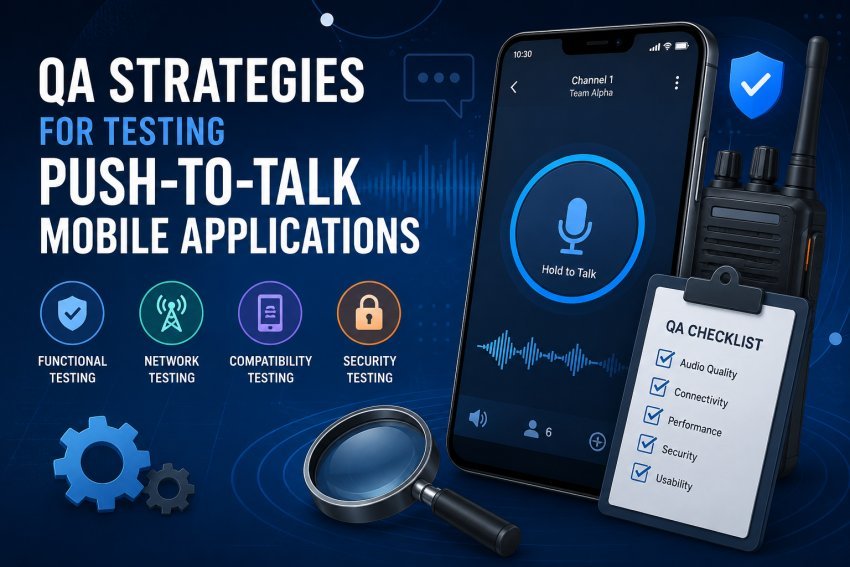

The enterprise mobility landscape is rapidly evolving, with Push-to-Talk over Cellular (PoC) applications increasingly connecting remote field workers and mission-critical teams. Across industries like mining, logistics, and emergency services, reliable voice communication is essential for safe and efficient operations. However, replacing traditional physical communication tools with software applications presents a unique set of quality assurance hurdles. QA engineers must rigorously test these mobile apps to ensure they can deliver uninterrupted, high-fidelity voice transmission even under severe network congestion.
Establishing Hardware Latency Benchmarks
To establish an effective testing baseline, QA teams must look at the hardware these modern applications aim to replace. For decades, physical transceivers have set the industry standard for instant, fail-proof communication in challenging environments. In testing laboratories, engineers frequently benchmark mobile app response times against dedicated hardware such as Motorola two way radios to measure true operational efficiency. Unlike consumer mobile devices that often suffer from operating system background delays and lock-screen friction, traditional physical hardware features dedicated buttons that transmit audio instantaneously. Ensuring a software application can successfully replicate this exact instantaneous experience is the fundamental goal of performance testing.
Quantifying Mouth-to-Ear Latency and Voice Quality
Once a reliable hardware baseline is understood, software testers must measure how efficiently the application processes and transmits voice packets across digital cellular networks. The 3rd Generation Partnership Project (3GPP) has established strict standards for Mission Critical Push-to-Talk to guarantee prioritised voice transmission during heavy network loads. Furthermore, government technology standards bodies have created rigorous measurement frameworks for these software deployments. Specifically, the National Institute of Standards and Technology (NIST) established methodologies to quantify mouth-to-ear (M2E) latency as a core Key Performance Indicator for quality of experience in voice communications.
Alongside strict latency measurements, testers evaluate voice intelligibility using Perceptual Objective Listening Quality Analysis (POLQA) scores. This standard helps engineers evaluate the degradation of audio across various mobile networks, ensuring the app maintains vocal clarity even when data compression techniques are aggressively applied. Additionally, the European Telecommunications Standards Institute (ETSI) mandates testing for Call Access and Join capabilities to ensure users can enter active communication channels without software hesitation.
Network Simulation and Device Integration Workflows
Testing specialised voice communication software requires a hyper-focused approach to network emulation and reliability. When addressing common mobile app testing challenges, QA engineers often simulate poor 4G or 5G network conditions to measure voice latency and overall application stability. Testers utilise network proxy tools like Charles Proxy and Fiddler to intentionally throttle bandwidth and simulate fluctuating packet loss. This validates how the application handles rapid transitions between cellular networks and weak enterprise Wi-Fi environments.
Automating these scenarios is equally critical. QA teams frequently deploy automated test scripts using frameworks like Appium to repeatedly simulate network drops and reconnections over hundreds of iterations. This ensures that any memory leaks or resource exhaustion issues are identified well before the application is deployed to production.
To accurately validate device integration and software reliability, QA teams should focus on several specific testing protocols:
- Network Jitter Evaluation: Testers must evaluate the software against network jitter (the variability in packet arrival times) to ensure it does not severely distort voice clarity in the field.
- Background Execution Optimisation: Mobile voice apps must contend with aggressive battery optimisation by both iOS and Android. Testers must ensure the app does not suffer from poor background execution, which can result in severe battery drain of up to 40 percent during a standard 12-hour shift.
- Audio Codec Benchmarking: Standardised testing requires validating data compression efficiency. For example, testing the Opus audio codec ensures it consumes roughly 300 kilobytes of data per minute of speech while maintaining high conversational intelligibility.
- Interruption Management Workflows: Testers must validate how the application behaves when the mobile device simultaneously receives a standard phone call, a push notification, or switches abruptly to an offline mode.
Validating Hardware-to-Software Synergies
Beyond network metrics, the physical interaction between the field worker and the mobile device is a crucial area of testing. Enterprise QA protocols include specific button tests to verify that remapped physical smartphone keys, such as volume rockers or programmable action buttons, can consistently trigger the app’s microphone. Furthermore, Apple recently introduced a dedicated framework in iOS for push-to-talk services. This requires QA teams to rigorously test whether audio can be transmitted and received without the user needing to wake the device screen.
Testers must also account for external Bluetooth peripherals like remote speaker microphones and headsets, which are commonly utilised by workers who need to keep their hands free. QA engineers need to verify that pairing these accessories does not introduce additional latency or cause audio routing failures during active transmission.
Ultimately, the goal of testing mobile voice applications is to ensure that enterprise users experience the same reliability and speed they have come to expect from traditional physical systems. By combining stringent latency benchmarks with comprehensive network simulation, software testers can guarantee that these mission-critical applications perform flawlessly in the most demanding operational environments.