
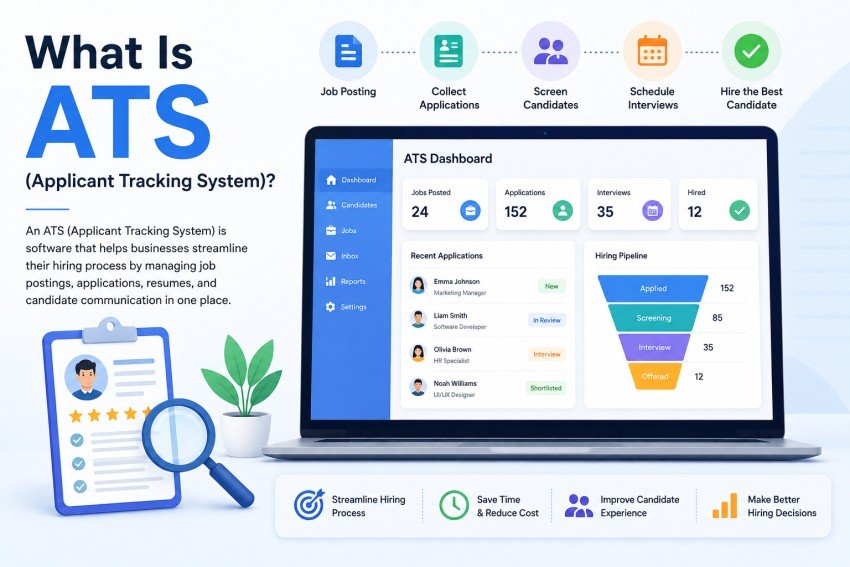

ATS is the abbreviation for Applicant Tracking System. Companies sometimes use it to manage job postings, gather and select resumes, and track candidates through the recruitment process. It acts as the digital database that assists human resources in cutting through bigger application volumes. Main features of an applicant tracking system entail job posting, resume parsing, keyword filtering, and workflow automation.
According to various statistics:
· The worldwide ATS market is projected to go from nearly $7.43 billion to $7.94 billion, with non-stop growth estimated through 2030.
· An effective ATS can reduce the average recruitment time by 60%.
· Nearly 92% of job seekers leave or never finish online job applications because of poor interfaces.
Are you working hard to upgrade your resume but have not had any interviews? More employers are incorporating Applicant Tracking Systems (ATS) to screen CVs. Your CV can be rapidly scanned if the correct keywords are not present.
September is celebrated as the International Update Your Resume Month. This is the time to think about your CV with AI in mind. Today, companies are immensely dependent on Applicant Tracking Systems (ATS) to organize their recruitment procedures; these systems scan CVs for keywords and arrange them based on significance to the job description. This shows that your resume is required to be optimized to pass through these filters and go in front of the hiring manager.
Applicant Tracking Systems (ATS) often utilize AI (artificial intelligence) and machine learning algorithms to improve their functionality. These technologies assist ATS in analyzing and ranking CVs more effectively. This diagram below explains the concept above:
Before beginning to upgrade your CV, you must make sure to accurately define the title or role you want to apply for. Optimize your resume for ATS to raise your probability of attaining more interviews once you are clear on the role you are looking for. Here are some tips to optimize your ATS.
8 Tips To Optimize Your Applicant Tracking System
1. Use Pertinent Keywords
One of the most significant aspects of optimizing your resume for ATS is incorporating the pertinent keywords that match the job description and the skills, qualifications, and experiences the employer is looking for. Carefully read the job posting and highlight the key skills, qualifications, and responsibilities mentioned. These are the keywords you should include in your resume.
2. Incorporate a clean and Simple Format
ATS can have difficulty reading difficult resume formats. Therefore, you are advised to use clear section headings like certifications, skills, education, and experience. You must avoid creative section titles that might confuse the ATS. You are also advised to use a standard font like Times New Roman, Calibri, or Arial. Quantify your achievements and utilize bullets by including numbers showing your impact, like raising sales by 30% or managing a team of 15 people.
3. Don’t Put A Picture On Your CV
Incorporating a picture on your resume is generally not suggested, particularly in the United States or Canada and other countries where there are stringent anti-discrimination laws. Adding your photos can decrease the probability of hiring.
4. Select the Correct File Type
The file type you select can impact the way ATS reads your resume. Incorporate PDFs and Word documents. Some ATS may have difficulty reading text in footers and headers. Therefore, keep significant information out of these areas.
5. Customize Your Resume For All Job Applications
Tailor your resume for every job application to match the particular keywords and requirements of the job posting. Various career experts have suggested that resumes have evolved over the years. They are moving away from a generalized document to one customized document for every single job application. Perhaps this sounds time-consuming. However, concentrate on tailoring the title and the summary section or Bio to match every job application.
6. Never Forget To Include A Core Competencies Section
When you are working on your resume, including a basic skill section can increase the probability of your resume being recognized by the Applicant Tracking System. You should list your relevant skills by aligning them with the keywords from the job description. If you aim for a one-page CV, consider dividing it into two halves. Utilize the left half for skills and personal data and the right half for awards, education, and experience.
7. Assess Your CV with the ATS Tools
You can incorporate online tools to assess the way it will perform in an ATS prior to submitting your resume.
8. Focus on Relevancy
Last but not least, cut unimportant or irrelevant details or experiences. Erase irrelevant or outdated information that doesn’t align with the job that you are applying for. Your CV must highlight your most pertinent or recent experiences.
Conclusion
Optimizing your CV for ATS is important in the job application process. By incorporating relevant keywords, balancing ATS optimization with readability for the human eye, selecting the correct file type, and maintaining a clean format, you can increase the probability of getting noticed and landing more interviews. Begin applying these plans now to make your resume stand out in this crowded job market.
The candidate can benefit from rapid responses to applications (whether positive or negative). It also allows them to optimize their resume and highlight relevant skills that demonstrate the needs in the job description.
An ATS provides rapid access to enhanced candidates while creating a reusable database of contacts for upcoming hirings. By organizing the recruitment scanning, this reduces the cost per hire, and the savings can be implemented anywhere else. It also provides the hiring manager more time to individually see candidates and make them feel valued. This is important for employee retention.
Even if the candidate is not selected for a particular role, the ATS will still add them to a dataset that is reuseable that can be searched in the near future. A hiring manager can reach out individually to a previous applicant and allow them to apply for a position that suits their skill set better. This increases candidate engagement and improves the company’s reputation as an attractive employer.
Frequently Asked Questions (FAQs)
How does ATS tracking work?
An Applicant Tracking System (ATS) is software that companies use to collect, store, and manage job applications during the hiring process.
· Job Posting
· Resume Parsing
· Screening and Ranking
· Candidate Tracking
· Automation
Is 80% a good ATS score?
Yes, an 80% ATS score is generally considered a good and solid match that will successfully pass most automated resume filters.
How do I pass my CV through ATS?
To pass an Applicant Tracking System (ATS), use a simple, single-column layout with standard text, clear headings like “Experience” and “Education”, and relevant keywords copied directly from the job description. Avoid tables, text boxes, graphics, and headers or footers.