
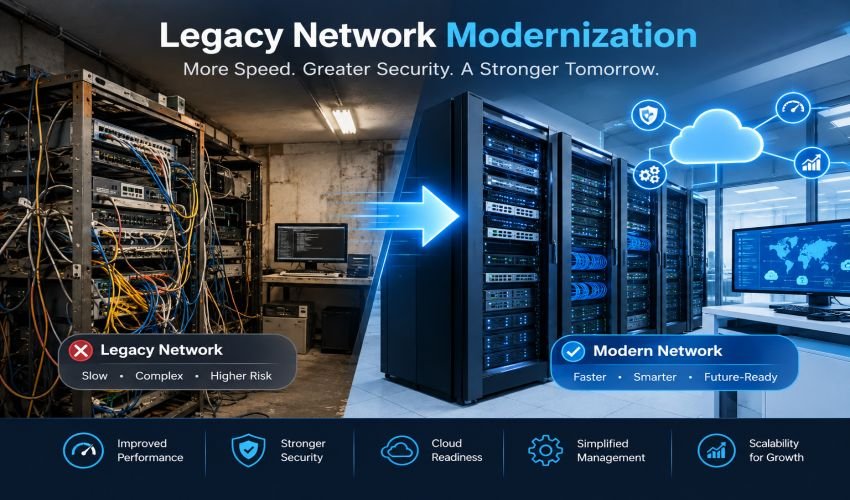

For many growing organizations, legacy network infrastructure remains in place far past its intended operational lifespan. As long as routers pass packets, switches maintain link lights, and local servers remain accessible, business leaders often prioritize other capital investments. However, as companies adopt cloud-based applications, expand remote access, and integrate bandwidth-heavy communication platforms, older network architectures inevitably hit a wall.
Legacy networks were engineered for an era when most data lived on physical servers inside a central office building. Modern business workflows, by contrast, rely on real-time data synchronization across multiple geographic locations, cloud environments, and mobile endpoints. When outdated hardware and legacy routing protocols are forced to handle modern traffic patterns, organizations experience subtle performance degradation, sudden outages, and expanding cybersecurity vulnerabilities.
Comprehensive Infrastructure Auditing and Discovery
The first phase of network modernization involves a thorough inventory and assessment of existing technology assets. Before introducing new equipment or reconfiguring IP subnets, engineers must map the physical and logical layout of the current network. This discovery process frequently uncovers shadow IT deployments, unmanaged switches tucked under desks, expired security licenses, and undocumented legacy configurations.
A comprehensive audit evaluates several key components:
- Physical Layer Integrity: Inspecting server room rack management, patch panels, power delivery systems, and cabling standards (such as Cat5e versus Cat6a or fiber optics).
- Traffic Flow and Utilization: Measuring peak bandwidth consumption, latency across local subnets, and throughput bottlenecks between local devices and cloud gateways.
- Device Lifecycle Status: Identifying hardware that has reached End-of-Life (EOL) or End-of-Service-Life (EOSL), meaning manufacturers no longer issue security patches or firmware updates.
- Application Dependency Mapping: Documenting which business applications rely on local database connections, proprietary legacy protocols, or specific port configurations.
Uncovering these baseline metrics ensures that the replacement architecture is sized correctly for both current operational demands and future growth. Leveraging managed services for Marietta businesses allows regional organizations to conduct these technical evaluations without pulling internal staff away from day-to-day operations.
Managing Planned Operational Friction and Cutovers
A primary concern for executives considering a network upgrade is the potential for business interruption. Modernizing critical infrastructure inevitably requires scheduled downtime, particularly when swapping core routing equipment, replacing central switches, or reconfiguring firewall rule sets.
To minimize friction, modernization projects rely on phased implementation strategies rather than single-night “big bang” cutovers. System architects build and test the new network topology in parallel with the existing system. Once the new environment is fully staged and validated, migration occurs during pre-planned maintenance windows, such as late evenings or weekends.
According to insights published by Forbes, successful legacy technology updates require breaking complex migration projects into smaller, incremental stages to maintain operational continuity and reduce implementation risk. Staged cutovers allow technical teams to migrate individual departments or functional subnets one at a time. If an unforeseen configuration issue arises, rollback procedures can be executed swiftly without paralyzing the entire enterprise. Clear communication with department heads regarding scheduled downtime ensures that employees can plan their workloads around maintenance windows.
Shifting from Perimeter Security to Zero-Trust Architecture
Legacy networks relied heavily on perimeter-based security models, often described as a “castle-and-moat” strategy. Once a device successfully connected to the local office network or logged in via a basic Virtual Private Network (VPN), it was generally granted broad access to internal resources. Modern security frameworks have rendered this approach obsolete.
Network modernization upgrades the security layer by implementing micro-segmentation and Zero-Trust Network Access (ZTNA) principles. Under a modern network design:
- Implicit Trust Is Eliminated: Every user and device must be explicitly authenticated and continuously authorized before accessing specific applications, regardless of whether they are physically inside the office or working remotely.
- Network Segmentation Is Enforced: Guest Wi-Fi, corporate workstations, IP security cameras, payment processing systems, and internal database servers are isolated into distinct Virtual Local Area Networks (VLANs). If an endpoint in one segment becomes compromised, the breach is contained automatically, preventing lateral movement across the network.
- Next-Generation Firewalls (NGFW) Deploy Real-Time Inspection: Modern security gateways analyze traffic at the application layer, blocking advanced malware, intrusion attempts, and unauthorized data exfiltration in real time.
Infrastructure Convergence and Bandwidth Optimization
Upgrading legacy hardware fundamentally changes how data travels through an office. Modern network switches feature much higher backplane capacities, multi-gigabit port configurations, and high-wattage Power over Ethernet (PoE+) capabilities. This allows a single network drop to power high-definition IP cameras, access control panels, and modern Wi-Fi 6/6E access points simultaneously, eliminating the need for dedicated electrical wiring at every endpoint.
Furthermore, modernization introduces Software-Defined Wide Area Networking (SD-WAN) technologies. Legacy branch connections historically relied on expensive, rigid Multiprotocol Label Switching (MPLS) circuits to route data between offices. SD-WAN dynamically manages multiple internet connections, such as high-speed fiber, broadband, and 5G backup lines. The system automatically routes critical voice and video traffic over the fastest, most stable link while sending routine web traffic over secondary connections. If a primary internet provider experiences an outage, traffic fails over instantaneously without dropping active phone calls or cloud sessions.
Post-Deployment Tuning and Proactive Monitoring
Completing the physical installation and software configuration is not the final step in a network transformation. The days following a cutover require active monitoring, traffic analysis, and fine-tuning.
Even with meticulous pre-migration planning, real-world user behavior introduces unexpected traffic patterns. Technical teams monitor network telemetry to identify bandwidth hogs, resolve dynamic IP assignment conflicts, and optimize Quality of Service (QoS) rules for real-time collaboration tools.
Modernized networks feature high levels of observability. Integrated network management platforms provide continuous visibility into device health, CPU loads, link saturation, and security events. Instead of waiting for users to report slow load times or broken connections, system administrators receive automated alerts regarding early performance anomalies. This proactive monitoring approach shifts network management from reactive firefighting to continuous performance optimization.
Building a Resilient Digital Foundation
Modernizing a legacy network requires careful planning, technical expertise, and an initial investment of capital and operational effort. However, the long-term returns in system reliability, employee productivity, and robust cybersecurity far outweigh the temporary friction of implementation. By replacing fragile legacy hardware with an adaptive, policy-driven network architecture, organizations establish a secure, scalable foundation capable of supporting modern business initiatives for years to come.