
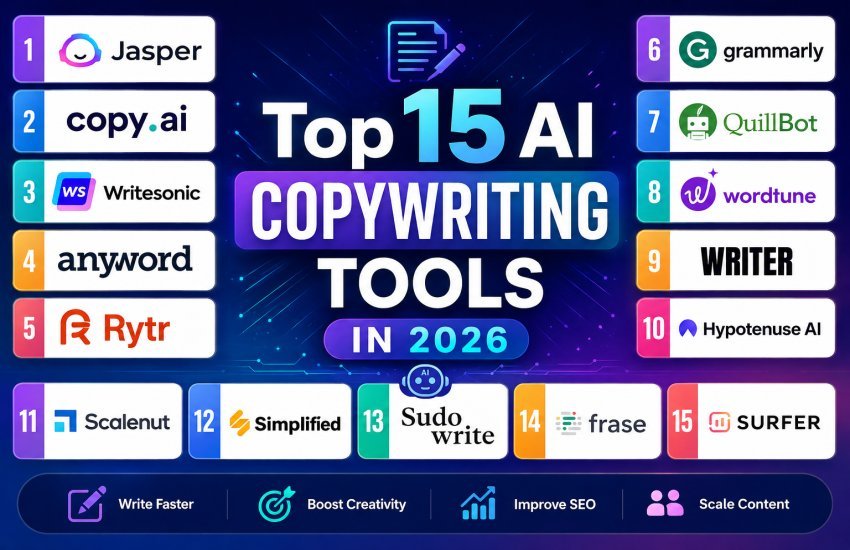

Creating good marketing copy takes more than putting words on a page. A strong headline needs to attract attention, product copy needs to explain value, an email needs to encourage action, and an advertisement needs to communicate its message within seconds. For marketers handling several channels at once, producing all of this content consistently can become a major workload.
That is why AI copywriting tools have become an important part of modern content workflows.
In 2026, these platforms are no longer limited to basic text generation. Many now include brand-voice controls, SEO research, content optimization, workflow automation, rewriting, product-content generation, campaign assistance, and integrations with other marketing systems.
The growing adoption of AI in marketing also shows why these tools deserve attention. HubSpot’s 2026 State of Marketing research reports that 86.4% of marketing teams use AI in at least some marketing activities, while content creation is one of the leading applications. HubSpot’s 2026 report also says 80% of marketers use AI for content creation.
However, more AI does not automatically mean better content. The same technology that makes content production faster can also make the internet more repetitive. HubSpot’s 2026 research found that 71% of marketers say AI helps them create significantly more content, while 53% struggle to make that content stand out.
So, the best approach is not to ask which tool can “write everything for you.” Instead, ask which platform is best suited to your particular job.
This guide examines 15 leading AI copywriting and AI writing platforms for 2026, including their strengths, ideal users, useful features, limitations, and situations where each tool makes the most sense.
What Are AI Copywriting Tools?
AI copywriting tools use artificial intelligence and language models to help users create, rewrite, expand, summarize, or improve written content.
Depending on the platform, you can use them for:
- Blog introductions and articles
- Website copy
- Landing pages
- Product descriptions
- Email campaigns
- Social media posts
- Advertising copy
- Headlines and taglines
- SEO content
- Meta descriptions
- Sales messages
- Content repurposing
- Editing and rewriting
The important difference between platforms is how they approach writing.
Some are designed primarily for marketing teams. Others focus on SEO. Some are better for ecommerce product descriptions, while others are built around editing existing writing. A few are specialized for creative or fiction writing rather than commercial copy.
That distinction becomes important when choosing a tool.
How We Selected These 15 Tools
For this comparison, the tools were considered across several practical areas:
Writing quality: Does the platform produce useful first drafts that require a reasonable amount of editing?
Marketing capabilities: Does it understand advertising, campaigns, product messaging, email, and other commercial formats?
Brand control: Can users maintain a consistent tone, style, and messaging?
SEO capabilities: Does the platform help with search-focused content and optimization?
Workflow: Can teams move from idea to finished content without constantly switching platforms?
Specialization: Does the product perform particularly well for a specific type of writing?
Value: Does the feature set make sense for the intended audience?
Prices and features change frequently, so pricing should always be confirmed on the provider’s current website before purchasing.
Best AI Copywriting Tools for Marketing Teams
1. Jasper

Best for: Marketing teams, brand content, campaigns, and enterprise marketing workflows
Jasper remains one of the most recognizable names in AI-assisted marketing content, but its positioning has expanded considerably. Rather than presenting itself simply as an AI article writer, Jasper now focuses heavily on marketing workflows, AI agents, brand intelligence, content pipelines, and campaign execution.
Its current platform includes tools for content creation, optimization, research, translation, marketing workflows, and brand control. Jasper says its IQ layer can incorporate brand voice, audience profiles, style guides, and product knowledge into generated content.
This makes Jasper particularly interesting for companies where consistency matters.
For example, a marketing department could use one brand voice for website content, another approved style for social media, and specific audience information when creating campaign assets.
Jasper also supports more than isolated pieces of copy. Its current platform is designed around connected marketing workflows, which can be useful when a campaign requires multiple assets rather than one blog post.
Main strengths
Jasper is especially strong when a company needs:
- Consistent brand voice
- Marketing campaign workflows
- Multiple content formats
- Team collaboration
- Enterprise controls
- AI-assisted marketing operations
Its current Pro plan is listed at $69 per month when billed monthly or $59 per month when billed annually, while Business pricing is customized.
Potential limitation
Jasper may be more platform than an individual writer needs. Freelancers who only want occasional captions or short product descriptions may find simpler tools more practical.
2. Copy.ai

Best for: Go-to-market teams, sales, marketing workflows, and business content
Copy.ai has evolved from a straightforward copy-generation platform into a broader go-to-market AI platform.
Its current positioning focuses heavily on workflows that connect marketing, sales, and operations. Instead of asking users to generate every piece of copy individually, Copy.ai emphasizes repeatable processes.
This can be useful for organizations that regularly create similar types of content.
For example, a company launching a new product might need product messaging, sales emails, campaign material, website copy, and follow-up content. A workflow-oriented platform can help standardize those processes.
Copy.ai’s current plans include access to multiple AI models and customizable workflows. Its pricing page lists a 5-seat plan at $29 per month when billed monthly or $24 per month when billed annually, while higher-level business plans add workflow credits and additional capabilities.
Main strengths
Copy.ai is a strong choice for:
- Sales content
- Marketing operations
- GTM workflows
- Content repurposing
- Repeatable business processes
- Teams that need multiple AI models
Potential limitation
If your only requirement is rewriting a paragraph or generating a short caption, Copy.ai’s broader workflow capabilities may be unnecessary.
3. Writesonic

Best for: SEO content, marketing copy, AI-assisted research, and content teams
Writesonic has built its reputation around AI-powered writing and marketing content, with a strong emphasis on search-focused content.
It can be used for blog content, advertisements, product descriptions, social media copy, and other marketing materials. Its broader platform also includes AI-powered research and content workflows.
One reason it stands out is that it attempts to combine writing with other stages of the content process rather than treating generation as a standalone task.
For an SEO team, this can be useful because writing is only one part of producing a search-focused article. Research, structure, optimization, internal linking, and updating are also important.
Main strengths
Writesonic can be useful for:
- SEO content
- Blog writing
- Marketing copy
- Product descriptions
- Content research
- Short-form copy
- Content optimization
Potential limitation
AI-generated long-form content still needs editorial review. Even when the structure looks convincing, facts, examples, claims, and search intent should be checked before publication.
4. Anyword

Best for: Performance-focused marketing copy
Anyword takes a slightly different approach by focusing strongly on marketing performance.
Rather than simply asking whether a sentence sounds good, performance-oriented copywriting asks a more useful question: Is this message likely to work for the intended audience and channel?
That makes Anyword interesting for marketers working with advertisements, landing pages, emails, social media, and other conversion-focused content.
The platform can help generate different messaging variations and refine copy for particular audiences and marketing purposes.
Main strengths
Anyword is worth considering for:
- Advertising copy
- Conversion-focused messaging
- Marketing variations
- Audience-specific content
- Performance-oriented marketing teams
Potential limitation
Performance predictions are not guarantees. A tool can provide useful guidance, but real-world results still depend on the offer, audience, creative assets, distribution, timing, and market conditions.
5. Rytr

Best for: Freelancers, small businesses, and budget-conscious writers
Rytr is one of the more approachable choices for people who want AI assistance without immediately moving into a large enterprise marketing platform.
Its current plans include a free option, an Unlimited plan, and a Premium plan. The official pricing page currently lists Unlimited at $7.50 per month and Premium at $24.16 per month when billed annually.
Rytr supports use cases including email writing, SEO meta titles, review responses, paragraph generation, social posts, captions, and calls to action.
Main strengths
- Accessible pricing
- Simple interface
- Multiple writing use cases
- Tone-of-voice matching
- Browser extension
- Plagiarism-checking options
Potential limitation
Rytr is better suited to everyday copywriting assistance than complex enterprise marketing operations.
6. Grammarly

Best for: Editing, rewriting, polishing, and improving existing copy
Grammarly has moved well beyond traditional grammar checking.
Its AI Writer can help users move from an idea to a draft, while its rewriting capabilities can make existing sentences clearer, sharper, or more appropriate for a particular tone. Grammarly describes its AI Writer as a way to generate drafts and refine writing while keeping the user’s voice central.
This makes Grammarly particularly valuable for people who already have ideas or drafts but want help improving them.
For example, a marketer could write a rough product announcement and ask Grammarly to make it more concise, professional, friendly, or persuasive.
Main strengths
- Grammar and clarity
- Rewriting
- Tone improvement
- Draft generation
- Everyday business communication
- Editing existing content
Potential limitation
Grammarly is not primarily an end-to-end SEO content research platform. It works best when improving communication rather than replacing an entire content strategy.
7. QuillBot

Best for: Paraphrasing, rewriting, summarizing, and improving existing text
QuillBot is particularly useful when you already have content and want to change how it is expressed.
Its suite includes paraphrasing and other writing-related tools. That makes it useful for editors, students, marketers, and professionals who need to restructure existing material.
For copywriters, this can be useful when a message needs several variations.
For example, one product benefit could be rewritten for a website, social media post, email, and advertisement without manually starting from scratch each time.
Main strengths
- Paraphrasing
- Rewriting
- Summarization
- Editing assistance
- Content repurposing
- Simple workflow
Potential limitation
Rewriting is not the same as creating original strategy. Users still need to ensure that the resulting copy is accurate, meaningful, and genuinely useful.
8. Wordtune

Best for: Rewriting and improving everyday professional writing
Wordtune focuses heavily on helping users express existing ideas more clearly.
It can rewrite sentences, improve fluency, and assist with summarization. Its current plans include a free Basic option, paid Advanced and Unlimited tiers, with usage and feature availability varying by plan.
This makes Wordtune particularly useful for professionals who write emails, reports, social posts, internal messages, or short marketing copy.
Main strengths
- Rewriting
- Clarity improvements
- Grammar refinement
- Summarization
- Everyday professional writing
Potential limitation
Wordtune is not designed to replace a complete marketing content strategy.
9. Writer

Best for: Enterprise teams, governed AI writing, and brand consistency
Writer is aimed at organizations that need more control over how AI is used.
Its current platform focuses on agentic AI, workflows, knowledge, governance, and organizational control. The company says its platform can use personality profiles, style guides, and data grounding to maintain brand and organizational requirements.
That distinction matters for large organizations.
A global company may have strict language requirements, legal guidelines, approved terminology, and different brand voices for different departments. A general-purpose AI chatbot may not provide the level of governance such an organization needs.
Main strengths
- Enterprise AI
- Brand consistency
- Governance
- Workflow automation
- Knowledge grounding
- Organizational controls
Potential limitation
Writer is likely excessive for a solo blogger looking for basic copy generation.
10. Hypotenuse AI

Best for: Ecommerce product content and large catalogs
Hypotenuse AI is especially interesting for ecommerce businesses because its platform is built around product information and content workflows.
The platform offers product descriptions, meta titles and descriptions, category pages, blog content, social media copy, advertisements, and other ecommerce content. Its current enterprise offering also includes product attribute enrichment, tagging, categorization, bulk workflows, and PIM/ERP integrations.
This is valuable for retailers managing hundreds or thousands of products.
Instead of manually writing every product description, a business can establish structured product information and use AI to help create consistent content at scale.
Main strengths
- Ecommerce copy
- Product descriptions
- Bulk generation
- Product data enrichment
- SEO/GEO optimization
- Ecommerce integrations
Potential limitation
Its strongest value is in ecommerce and structured product content, so a general blogger may not need its full feature set.
11. Scalenut

Best for: SEO-focused content teams and AI search optimization
Scalenut has expanded from AI-assisted SEO content toward a broader generative-engine-optimization approach.
Its current platform includes keyword clustering, content creation, content optimization, AI visibility tracking, internal linking, topic research, and related SEO functions. The company’s current plans start at $59 per month for Starter, with Plus at $89 and Professional at $199.
For publishers, agencies, and businesses that care about organic search, this broader workflow can be more useful than using a standalone AI writer.
Main strengths
- SEO content
- Keyword research
- Topic clusters
- Content optimization
- AI visibility
- Internal linking
- GEO-focused workflows
Potential limitation
The platform’s broad SEO feature set can be more complicated than a simple AI copy generator.
12. Simplified

Best for: Small marketing teams that want writing, design, publishing, and scheduling together
Simplified takes an all-in-one approach.
Its AI Writer is designed to create marketing copy, while the wider platform combines writing, design, publishing, and scheduling. The company currently promotes an AI writing workflow that can move from writing to design and publishing without requiring users to switch between several separate platforms.
This is useful for small marketing teams that do not want one application for copywriting, another for graphics, another for social scheduling, and another for publishing.
Main strengths
- AI writing
- Marketing templates
- Social content
- Design
- Publishing
- Scheduling
- Team workflows
Potential limitation
An all-in-one platform may not be the best choice if you already have specialized tools that your team prefers.
13. Sudowrite

Best for: Fiction writers, storytelling, scripts, and creative writing
Sudowrite deserves a place on this list because “copywriting” is not the only area where AI writing technology has developed.
Sudowrite is specialized for creative writing rather than advertising. Its current platform includes a Muse model for prose, Story Bible functionality, chapter-aware memory, and rewriting features designed to preserve a writer’s voice.
That makes it very different from Jasper, Copy.ai, or Anyword.
If your objective is to write a novel, short story, screenplay, or other narrative work, a specialized creative-writing platform can make more sense than a marketing-focused AI writer.
Main strengths
- Fiction
- Story development
- Character work
- Creative brainstorming
- Long-form narrative projects
Potential limitation
It is not the obvious choice for PPC advertisements, ecommerce descriptions, or corporate marketing campaigns.
14. Frase

Best for: SEO research, content briefs, and search-focused writing
Frase is useful for publishers who want AI writing to be connected to search research.
Instead of simply asking AI to write an article, SEO-focused platforms attempt to give the writer information about the topic, search results, headings, questions, and related concepts.
This can help when building content around search intent.
For example, a writer creating an article about cloud security can use an SEO content platform to identify relevant subtopics and questions before drafting.
Main strengths
- SEO research
- Content briefs
- Content optimization
- AI-assisted writing
- Search-focused workflows
Potential limitation
SEO software cannot guarantee rankings. Search visibility depends on content quality, competition, authority, technical SEO, links, user satisfaction, and many other factors.
15. Surfer

Best for: SEO content optimization and search-focused writing
Surfer is another platform where the emphasis is broader than simple copy generation.
Its Content Editor and AI writing capabilities are designed around search optimization. The platform evaluates content against search-related factors and provides guidance for improving coverage and structure.
Surfer’s current plans include Discovery, Standard, Pro, and Peace of Mind. Its pricing documentation also notes a 7-day Pro trial for new accounts.
For content teams, the benefit is the feedback loop: instead of generating text and publishing it immediately, writers can use optimization guidance to identify potential gaps before finalizing the article.
Main strengths
- SEO content optimization
- Content scoring
- AI writing assistance
- Keyword research
- Content auditing
- AI visibility features
Potential limitation
SEO optimization should never turn into keyword stuffing. Search-focused writing still needs original information, useful examples, clear answers, and a natural reading experience.
Quick Comparison of the 15 AI Copywriting Tools
| Tool | Best For | Main Strength |
|---|---|---|
| Jasper | Marketing teams | Brand-controlled marketing |
| Copy.ai | GTM teams | Workflows and sales/marketing |
| Writesonic | Content teams | SEO and AI content |
| Anyword | Performance marketers | Conversion-focused copy |
| Rytr | Freelancers | Affordable AI writing |
| Grammarly | Editors and professionals | Editing and rewriting |
| QuillBot | Content repurposing | Paraphrasing and rewriting |
| Wordtune | Professionals | Clearer everyday writing |
| Writer | Enterprises | Governance and brand control |
| Hypotenuse AI | Ecommerce | Product content at scale |
| Scalenut | SEO teams | SEO and GEO workflows |
| Simplified | Small marketing teams | Writing + design + publishing |
| Sudowrite | Fiction writers | Creative storytelling |
| Frase | SEO publishers | Research and content briefs |
| Surfer | SEO teams | Content optimization |
Which AI Copywriting Tool Should You Choose?
There is no single winner for everyone.
If you’re running a large marketing department, Jasper or Writer may be more appropriate because brand consistency, governance, workflows, and team management matter.
If you’re working on sales and go-to-market operations, Copy.ai deserves serious consideration because of its workflow-oriented approach.
For SEO-focused publishing, Writesonic, Scalenut, Frase, and Surfer are worth evaluating.
For ecommerce, Hypotenuse AI can be particularly useful because its feature set extends into product information management and bulk product content.
For a freelancer or small business, Rytr provides a simpler and more accessible starting point.
If your biggest problem is editing rather than generating, Grammarly, QuillBot, and Wordtune may be better choices.
And if you’re writing fiction, Sudowrite is much more specialized than general marketing AI platforms.
What Should You Look for Before Paying for an AI Copywriting Tool?
Before choosing a subscription, think about your actual workflow.
Check the type of content you produce
A tool that is excellent for advertisements may not be ideal for 2,000-word articles. Likewise, an SEO platform may be unnecessary if you mainly write email campaigns.
Start with your most common task.
Test brand voice
AI-generated content often sounds generic when it lacks context.
If brand consistency matters, test whether the platform can understand your preferred tone, terminology, audience, and messaging rules.
Check editing requirements
Don’t judge a platform only by how impressive the first paragraph looks.
Generate several pieces of content and examine how much editing they require. Look for repeated phrases, unsupported claims, awkward transitions, generic conclusions, and factual mistakes.
Review integrations
If your team works in WordPress, Shopify, Google Workspace, CRM systems, or other marketing platforms, integrations can save considerable time.
Consider scalability
A freelancer generating ten pieces of copy per month has different requirements from an ecommerce company managing 50,000 product pages.
The best tool is the one that matches your workload.
Can AI Copywriting Tools Replace Human Copywriters?
For most serious marketing work, they should not be treated as complete replacements.
AI can generate drafts extremely quickly, but effective copywriting involves more than sentence generation. Human marketers understand the customer, positioning, competitive landscape, product limitations, emotional context, and business objectives.
Current research supports a human-in-the-loop approach. HubSpot reported that only 7% of marketers publish AI-generated content without revising it. Another HubSpot study found that only 4% of marketers were using AI to write entire pieces of content for them, with most using AI for inspiration, outlines, or portions of drafts.
That is an important distinction.
AI is often most valuable when it accelerates the writer instead of replacing the writer.
A good workflow might look like this:
Human research → AI brainstorming → AI first draft → Human fact-checking → Human editing → Brand review → Publication → Performance analysis
This approach combines machine speed with human judgment.
How to Use AI Copywriting Tools Without Creating Generic Content
The biggest mistake is giving an AI tool a vague instruction such as:
“Write a blog post about digital marketing.”
The result will probably be broad and predictable.
Instead, provide useful context.
Tell the tool:
- Who the audience is
- What problem you’re solving
- What makes your product different
- What tone you want
- Which facts must be included
- What should be avoided
- What action the reader should take
- What examples are relevant
- What information requires verification
You should also provide real brand material when the platform supports it.
For example, instead of asking an AI tool to create an advertisement from nothing, provide your product benefits, customer objections, target audience, offer, tone, and previous high-performing campaigns.
The output will generally become more useful because the system has more context.
Important Limitations of AI Copywriting
Despite their progress, AI writing platforms still have weaknesses.
Accuracy
AI can generate information that sounds convincing but is incorrect. Important statistics, product specifications, legal claims, medical information, financial data, and current events should be verified.
Originality
Generating thousands of articles from similar prompts can produce repetitive content. Original research and firsthand experience remain valuable ways to differentiate content.
Brand risk
A poorly reviewed AI-generated advertisement can contain inappropriate wording, unsupported claims, or messaging that does not fit the company’s identity.
Over-optimization
SEO-focused AI tools can encourage writers to focus too heavily on keywords and competitor patterns. Optimization should support readers, not make the content awkward.
Lack of human experience
AI can summarize an experience, but it cannot replace genuine firsthand knowledge. A real customer story, expert observation, product test, or original case study can add value that generic AI writing cannot easily reproduce.
Final Verdict: Which AI Copywriting Tools Are Best in 2026?
The AI writing market has matured considerably. The best platforms are no longer competing only on who can generate the longest article. They are increasingly competing on context, brand control, workflow automation, search visibility, personalization, and measurable marketing outcomes.
For enterprise marketing, Jasper and Writer stand out for brand and organizational control. Copy.ai is particularly interesting for go-to-market workflows, while Writesonic, Scalenut, Frase, and Surfer are strong options for SEO-oriented teams.
For ecommerce, Hypotenuse AI offers a specialized approach to product content. For smaller teams and individuals, Rytr and Simplified can provide a more accessible workflow. Grammarly, QuillBot, and Wordtune are especially useful when the goal is improving existing writing rather than generating everything from scratch. And for creative writers, Sudowrite offers a specialized experience that general marketing platforms do not.
The most important lesson is that there is no universal “best” AI writing platform.
The right choice depends on what you write, who you write for, how much content you produce, how much control your brand requires, and how much human editing you are prepared to provide.
In 2026, the smartest use of AI copywriting tools is not pressing a button and publishing whatever comes out. It is building a workflow where AI handles repetitive parts of the writing process while humans provide strategy, expertise, originality, fact-checking, and final judgment.
That combination is much more likely to produce content that is not only faster to create, but also genuinely useful to readers.
Recommended image placement
For your article, I recommend using the homepage images immediately below each tool’s H2 heading, as shown above. If you want a cleaner article design, use one screenshot for every 2–3 tools instead of 15 separate screenshots. The screenshots should be treated as visual references, and you should use the latest screenshots from each company’s official website when publishing because interfaces can change.
Short FAQs
1. What are AI copywriting tools?
AI copywriting tools use artificial intelligence to create, rewrite, and improve marketing content such as ads, emails, product descriptions, and blog copy.
2. Which AI copywriting tool is best in 2026?
The best tool depends on your needs. Jasper, Copy.ai, Writesonic, ChatGPT and Deepseek are popular options for different content and marketing tasks.
3. Can AI copywriting tools replace human writers?
Not completely. They can speed up research, drafting, and editing, but human review is still important for accuracy, originality, brand voice, and creativity.
4. Are AI copywriting tools good for SEO?
Yes. Many tools can help create SEO-focused content, headlines, descriptions, and keyword ideas. However, content should still satisfy search intent and provide genuine value.
5. Are AI copywriting tools free?
Some offer free plans or trials, while advanced features usually require a paid subscription.
6. Can AI tools create ad copy?
Yes. Many AI writing platforms can generate copy for Google Ads, social media campaigns, landing pages, and other advertising formats.
7. How should businesses use AI copywriting tools?
Businesses should use them as productivity assistants for brainstorming, drafting, rewriting, and scaling content while keeping human editors involved in the final review.