

Software quality is one of the most important parts of modern software development. A small bug in an application can create a poor user experience, cause financial losses, expose sensitive information, or damage a company’s reputation. That is why software teams need professionals who can test applications, improve development processes, automate repetitive checks, and help developers build more reliable software.
However, the quality assurance field has several job titles, and they can be confusing.
You may see positions such as QA Tester, QA Engineer, QA Automation Engineer, and SDET (Software Development Engineer in Test). Some companies use these titles differently, while others treat them as separate career levels or specializations.
So, what is the difference?
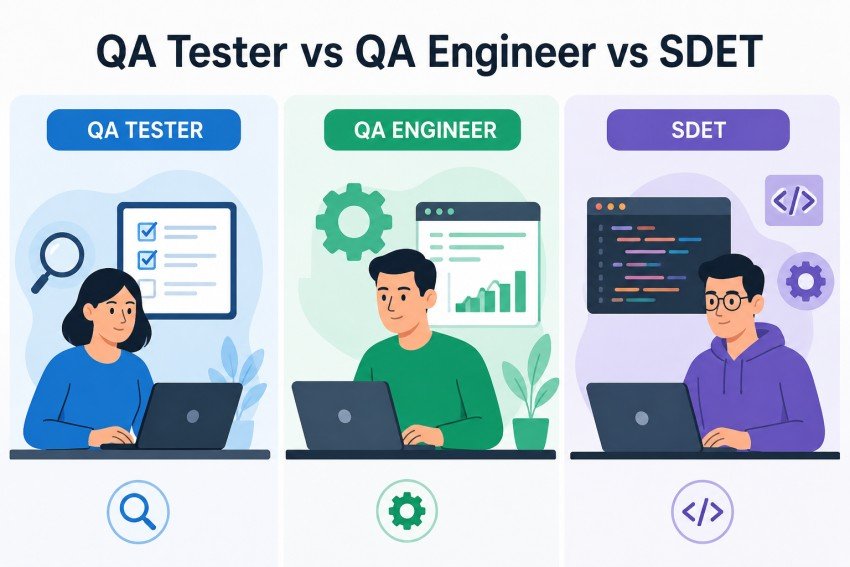
A QA Tester usually focuses heavily on testing software and finding defects. A QA Engineer generally has a broader role that can include test planning, process improvement, manual testing, and automation. A QA Automation Engineer focuses more strongly on building and maintaining automated tests. An SDET goes further into software engineering by developing testing frameworks, tools, and code while working closely with developers.
This guide explains QA Tester vs QA Engineer vs SDET in simple language. It covers their responsibilities, technical and soft skills, common tools, testing approaches, career paths, salaries considerations, and the situations where one role may be more suitable than another.
What Is Software Quality Assurance?
Before comparing these roles, it is important to understand what QA actually means.
Quality Assurance is a broad approach to improving software quality. It is not limited to running test cases after developers finish writing code.
QA can involve reviewing requirements, improving development processes, planning tests, defining quality standards, performing reviews, testing software, reporting defects, analyzing risks, and continuously improving the way software is developed.
Software testing is one important part of QA.
For example, a tester might check whether users can successfully log in to an application. A broader QA activity might involve reviewing the login requirements before development begins, making sure the team has clear acceptance criteria, defining test coverage, and establishing a process for handling defects.
GeeksforGeeks describes software testing as product-focused and primarily concerned with identifying defects, while QA focuses more broadly on improving development processes and preventing defects throughout the software development life cycle. It also describes software testing as a subset of QA.
This distinction is important because the job titles discussed in this article can have different levels of responsibility within that larger quality process.
QA Tester vs QA Engineer vs SDET: Quick Overview
Here is the simplest way to understand the three roles:
| Role | Main Focus | Coding Level | Automation | Typical Responsibility |
|---|---|---|---|---|
| QA Tester | Finding defects and validating features | Low to moderate | Optional | Execute tests and report bugs |
| QA Engineer | Testing plus quality processes | Moderate | Common | Plan, design, execute, and improve testing |
| SDET | Software engineering and test automation | High | Core responsibility | Build automation, frameworks, and testing infrastructure |
There is also an important role between a traditional QA Engineer and an SDET:
QA Automation Engineer
This professional specializes in automating software tests and building automation frameworks but may not have the same depth of software-engineering responsibility as an SDET.
These boundaries are not universal. A company may call someone a QA Engineer even when that person performs automation work that another company would assign to an SDET.
That is why it is better to understand the actual responsibilities of a job instead of judging a position only by its title.
What Is a QA Tester?
A QA Tester is primarily responsible for checking software to make sure it behaves according to requirements and identifying defects before users encounter them.
QA Testers may work mainly with manual testing, although some testers also use automation tools.
Their work often begins with understanding requirements and test scenarios. They then create or execute test cases, explore the application, identify unexpected behavior, document defects, and verify fixes.
A QA Tester may also think like a real user rather than simply following a checklist.
For example, imagine an online shopping website has introduced a discount-code feature.
A QA Tester might check:
- A valid discount code
- An expired discount code
- An invalid code
- A code below the minimum purchase amount
- Multiple discount codes
- Uppercase and lowercase input
- Empty fields
- Special characters
- Discount calculations
- Error messages
The goal is to discover situations that developers may not have considered.
The DEV Community article describes QA Testers as primarily focused on manual testing, including test execution, exploratory testing, regression testing, usability testing, and defect reporting.
QA Tester Responsibilities
Common responsibilities include:
Test Case Execution
The tester follows defined test cases to verify that software works as expected.
Defect Identification
When something does not work correctly, the tester documents the issue and provides enough information for developers to reproduce it.
Exploratory Testing
Exploratory testing allows testers to investigate the application without following only predefined test cases.
Regression Testing
After developers make changes, testers check existing functionality to ensure that the changes did not introduce new problems.
Usability Testing
The tester considers whether the application is understandable and convenient from a user’s perspective.
Test Documentation
QA Testers may maintain test cases, test results, defect records, and other testing documentation.
Skills a QA Tester Needs
A QA Tester does not necessarily need advanced programming skills, particularly in a manual testing position.
However, technical knowledge is still valuable.
Important skills include:
- Understanding software testing concepts
- Test case design
- Defect reporting
- Exploratory testing
- Regression testing
- Functional testing
- Basic database knowledge
- Basic SQL
- Understanding requirements
- Attention to detail
- Problem-solving
- Communication
- Analytical thinking
- User-focused thinking
Test Pro notes that QA testers can work with manual or automated testing, and manual testing does not necessarily require strong programming skills. It also highlights knowledge of databases, bug reporting, troubleshooting, test environments, quality standards, and user experience.
QA Tester Tools
QA Testers commonly work with tools for test management, defect tracking, communication, and documentation.
Examples include:
- Jira
- Bugzilla
- Mantis
- TestRail
- Zephyr
- Quality Center
- Confluence
- Trello
- Slack
The DEV Community example also shows how a tester might use TestRail for test cases and Jira for defect tracking.
The exact tools vary from company to company.
What Is a QA Engineer?
A QA Engineer generally has a broader technical and process-oriented role than a traditional QA Tester.
A QA Engineer may still perform manual testing, but the role can also include test planning, automation, test strategy, process improvement, API testing, test environment management, and collaboration with developers and product teams.
Instead of only asking:
“Does this feature work?”
a QA Engineer may also ask:
“How should we test this feature?”
“What risks should we consider?”
“How can we improve our testing process?”
“Which tests should be automated?”
“How can we get faster feedback from the development pipeline?”
This broader perspective makes QA Engineers valuable throughout the software development process.
The DEV Community article describes QA Engineers as professionals who design test plans, create test cases, combine manual and automated testing, improve QA processes, and collaborate with developers and stakeholders.
QA Engineer Responsibilities
A QA Engineer may be responsible for:
- Creating test strategies
- Developing test plans
- Designing test cases
- Executing manual tests
- Creating automated tests
- Performing API testing
- Reviewing requirements
- Managing test environments
- Tracking defects
- Improving testing processes
- Supporting regression testing
- Working with developers
- Communicating with product managers
- Monitoring test results
- Supporting CI/CD testing
The role is often more technical than a traditional manual QA position.
Skills a QA Engineer Needs
A strong QA Engineer usually needs a mixture of testing, technical, analytical, and communication skills.
Testing Knowledge
They should understand different testing levels and techniques, such as:
- Functional testing
- Regression testing
- Integration testing
- System testing
- Acceptance testing
- Exploratory testing
- API testing
- Performance testing
- Security testing
Technical Skills
Depending on the job, useful technical skills include:
- SQL
- APIs
- HTTP
- JSON
- Basic programming
- Version control
- Test automation
- CI/CD
- Databases
- Linux or command-line basics
Soft Skills
QA Engineers also need:
- Communication
- Collaboration
- Critical thinking
- Problem-solving
- Planning
- Time management
- Attention to detail
A QA Engineer often acts as a bridge between business requirements, development, and quality.
QA Engineer Tools
A QA Engineer may work with a wider toolset than a manual QA Tester.
Common examples include:
Test Management
- TestRail
- Zephyr
Defect Tracking
- Jira
API Testing
- Postman
Automation
- Selenium
- Cypress
- Playwright
CI/CD
- Jenkins
- GitLab CI
- CircleCI
Version Control
- Git
The DEV Community article specifically gives examples such as Selenium WebDriver, Postman, Jenkins, and GitLab CI for QA engineering work.
What Is a QA Automation Engineer?
A QA Automation Engineer specializes in automating software testing.
Instead of manually repeating the same test every time a developer changes the application, the automation engineer creates scripts that can perform those checks automatically.
For example, a manual tester might repeatedly check:
- Open the login page.
- Enter a username.
- Enter a password.
- Click Login.
- Verify the dashboard appears.
An automation engineer can write a test that performs these actions automatically.
This becomes especially useful when a team has hundreds or thousands of regression tests.
QA Automation Engineer Responsibilities
Common responsibilities include:
- Writing automated test scripts
- Maintaining automation suites
- Building automation frameworks
- Creating reusable test components
- Integrating tests with CI/CD
- Increasing automated test coverage
- Analyzing failed automated tests
- Reducing flaky tests
- Improving test execution speed
- Supporting regression automation
- Working with developers
- Maintaining test environments
The DEV Community article describes QA Automation Engineers as specialists who develop and maintain automated test scripts, build frameworks, integrate testing into CI/CD pipelines, and improve automated coverage and efficiency.
QA Automation Engineer Skills
Programming becomes much more important at this level.
Useful languages include:
- Java
- Python
- JavaScript
- C#
A QA Automation Engineer should also understand:
- Object-oriented programming
- Automation frameworks
- Web technologies
- APIs
- Git
- CI/CD
- Databases
- Debugging
- Test architecture
They do not necessarily need to be full-stack developers, but they need enough programming knowledge to create reliable and maintainable test automation.
QA Automation Tools
Popular tools can include:
Web Automation
- Selenium
- Cypress
- Playwright
Mobile Automation
- Appium
Test Frameworks
- JUnit
- TestNG
- Mocha
- NUnit
CI/CD
- Jenkins
- GitLab CI
- CircleCI
Version Control
- Git
The appropriate tool depends on the technology stack, application type, programming language, and requirements of the project.
What Is an SDET?
SDET stands for Software Development Engineer in Test.
An SDET is a highly technical quality professional who combines software development skills with deep testing knowledge.
The key difference is that an SDET does not simply automate existing manual test cases.
An SDET may design and build the automation framework itself.
They may also develop internal testing tools, create test infrastructure, improve application testability, work with developers on code quality, and build large-scale automated testing systems.
Test Pro describes an SDET as a combination of a developer and test engineer who can be involved from the beginning of a project and focuses heavily on designing, developing, and maintaining automated testing systems.
SDET Responsibilities
An SDET can be responsible for:
- Designing test frameworks
- Developing automation infrastructure
- Writing complex automated tests
- Creating testing tools
- Building API and integration tests
- Working with developers
- Improving code testability
- Supporting TDD and BDD practices
- Integrating tests into CI/CD
- Managing test environments
- Supporting performance testing
- Testing distributed systems
- Investigating complex failures
- Improving overall engineering quality
The role can extend well beyond traditional QA testing.
SDET Skills
SDETs generally require strong programming and software engineering knowledge.
Important skills can include:
Programming
- Java
- Python
- C#
- JavaScript or TypeScript
Software Engineering
- Object-oriented programming
- Data structures
- Design patterns
- Debugging
- Version control
- Code reviews
- Software architecture
Testing
- Automation
- Integration testing
- API testing
- Unit testing
- End-to-end testing
- Performance testing
- Regression testing
- TDD
- BDD
Infrastructure
Depending on the organization, SDETs may also work with:
- Docker
- Kubernetes
- Cloud platforms
- CI/CD systems
- Test environments
The DEV Community article gives examples of SDETs using development environments such as IntelliJ IDEA and VS Code, testing frameworks such as JUnit and TestNG, automation tools such as Selenium and Appium, and infrastructure technologies such as Docker, Kubernetes, and AWS.
SDET vs QA: The Core Difference
The biggest difference is the depth of software engineering involved.
A QA Tester may ask:
“Does the application work correctly?”
A QA Engineer may ask:
“How can we test the application effectively and improve the quality process?”
A QA Automation Engineer may ask:
“How can we automate these tests reliably and run them continuously?”
An SDET may ask:
“How can we build the automation architecture and engineering systems that make high-quality testing scalable?”
This does not mean one role is better than another.
They simply have different responsibilities and technical expectations.
Test Pro identifies the core distinction as the focus of the roles: QA professionals concentrate on evaluating software against user and quality requirements, while SDETs are more deeply involved in developing automated testing scripts and frameworks.
QA Tester vs QA Engineer vs SDET
| Factor | QA Tester | QA Engineer | SDET |
|---|---|---|---|
| Main focus | Software testing | Testing + quality engineering | Software engineering + testing |
| Manual testing | High | Medium to high | Lower |
| Automation | Optional | Common | Core responsibility |
| Programming | Basic or optional | Moderate | Advanced |
| Test cases | Executes and creates | Designs and manages | Automates and engineers |
| Framework development | Rare | Sometimes | Common |
| CI/CD | Basic awareness | Common | Strong knowledge |
| Coding | Limited depending on role | Moderate | Strong |
| Development involvement | Usually testing-focused | Cross-functional | Deep engineering collaboration |
| Test infrastructure | Limited | Some | Significant |
| Process improvement | Some | Strong | Strong |
| Strategic role | Usually limited | Moderate | Often broad |
| Best fit | Testing-focused career | Balanced QA career | Engineering-focused testing career |
These distinctions are general rather than universal. Job descriptions can overlap, and companies may use the same title for different responsibilities.
QA Tester vs QA Engineer vs SDET: Example
Imagine a company develops a mobile banking application.
The application includes:
- Login
- Account balance
- Money transfer
- Bill payment
- Transaction history
Now consider how the three roles might contribute.
QA Tester
The QA Tester may manually verify:
- Login with valid credentials
- Login with invalid credentials
- Balance display
- Money transfers
- Bill payments
- Error messages
- User interface behavior
They document defects and verify that fixes work.
QA Engineer
The QA Engineer may:
- Create the overall test plan
- Design test cases
- Perform API testing
- Execute manual tests
- Automate selected regression tests
- Work with developers
- Manage test environments
- Integrate tests into CI
SDET
The SDET may:
- Build the automation framework
- Create reusable test libraries
- Develop API and integration tests
- Create test data systems
- Integrate tests into the CI/CD pipeline
- Build scalable test environments
- Investigate automation failures
- Improve application testability
All three contribute to the same goal: delivering reliable software.
QA Tester vs QA Engineer vs SDET Career Path
There is no single career path that everyone must follow.
However, a common progression can look like this:
QA Intern / Junior Tester
          ↓
      QA Tester
          ↓
     QA Engineer
          ↓
QA Automation Engineer
          ↓
       SDET
          ↓
Senior SDET / QA Architect / Test Architect
This is only one possible path.
A person can also move from development into SDET work.
Another person may prefer manual testing and move toward:
QA Tester
    ↓
Senior QA Tester
    ↓
QA Lead
    ↓
QA Manager
    ↓
Head of QA
Someone who enjoys automation may choose:
QA Tester
    ↓
Automation Engineer
    ↓
Senior Automation Engineer
    ↓
SDET
    ↓
Senior SDET
    ↓
Test Architect
Career progression depends on technical skills, company structure, experience, and personal goals.
How to Become a QA Tester
QA testing is often one of the more accessible ways to enter the software industry.
Start by learning:
- Software testing fundamentals
- SDLC and STLC
- Test cases
- Test scenarios
- Bug life cycle
- Functional testing
- Regression testing
- Exploratory testing
- Basic SQL
- API testing basics
- Defect tracking tools
You should also practice testing real applications.
Do not only study theory.
Take a website or application and create your own:
- Test scenarios
- Test cases
- Bug reports
- Test summary
- Regression checklist
A practical portfolio can demonstrate your ability better than a list of theoretical terms.
How to Become a QA Engineer
If you are already comfortable with manual testing, the next step is to expand your technical skills.
Learn:
- SQL
- API testing
- Postman
- Git
- Basic programming
- Test automation
- CI/CD
- Test frameworks
- Browser developer tools
- Basic command-line skills
You should also learn how software is built.
Understanding development concepts makes it easier to communicate with developers and identify problems earlier.
How to Become a QA Automation Engineer
If automation interests you, choose one programming language first.
For example:
Java + Selenium
or
Python + Playwright
or
JavaScript/TypeScript + Playwright
Do not try to learn every automation tool at the same time.
Build small projects.
For example:
- Automate login
- Automate registration
- Automate search
- Automate checkout
- Automate API tests
- Generate test reports
- Run tests through CI/CD
Once you understand the fundamentals, learn framework design and maintainability.
Automation is not simply about writing scripts. Good automation should be reliable, reusable, readable, and easy to maintain.
How to Become an SDET
Becoming an SDET generally requires deeper software engineering knowledge.
You should be comfortable with:
- Programming
- Object-oriented design
- Data structures
- APIs
- Databases
- Git
- CI/CD
- Test architecture
- Automation frameworks
- Debugging
- Software design
You should also understand how developers work.
Learn how to:
- Read source code
- Review pull requests
- Write clean code
- Create reusable libraries
- Design scalable test systems
- Work with containers
- Understand cloud environments
An SDET should be able to think like both a tester and an engineer.
Do QA Testers Need Coding Skills?
Not always.
For a traditional manual QA role, strong programming skills may not be required.
A tester can perform many valuable activities without writing production-level code.
However, learning some coding can significantly expand career options.
Basic coding can help with:
- Test automation
- Data generation
- API testing
- Test utilities
- Debugging
- Log analysis
- Database queries
- CI/CD tasks
As you move toward QA Automation Engineer or SDET positions, programming becomes increasingly important.
Test Pro specifically distinguishes manual QA work, where coding may not be required, from automation and SDET roles where programming proficiency becomes essential.
Manual Testing vs Automation in These Roles
It is tempting to think:
QA Tester = manual
SDET = automation
But the reality is more flexible.
QA Testers can use automation.
QA Engineers can perform manual testing.
Automation Engineers may investigate problems manually.
SDETs may perform exploratory testing when necessary.
The difference is usually the primary focus and technical depth, not whether someone ever performs a particular type of testing.
Good testers understand that automation does not replace human thinking.
Automated tests are excellent for repetitive and predictable checks.
Humans are still valuable for exploratory testing, usability evaluation, unusual scenarios, and understanding how real users may interact with software.
What Tools Should You Learn?
You do not need to learn every QA tool available.
Instead, build a practical toolkit.
For Manual QA
Start with:
- Jira
- TestRail or Zephyr
- SQL
- Postman
- Browser developer tools
For QA Engineering
Add:
- Git
- Selenium or Playwright
- API testing
- Jenkins or GitHub/GitLab CI
- Basic programming
For QA Automation
Focus on:
- Selenium
- Playwright
- Cypress
- Appium
- JUnit/TestNG/NUnit/Mocha
- Git
- CI/CD
For SDET
Go deeper into:
- Programming
- Automation frameworks
- APIs
- Docker
- Kubernetes
- Cloud platforms
- CI/CD
- Performance testing
- Test architecture
The right tool depends on your target job. Learning a small number of tools deeply is generally more useful than knowing the names of dozens of tools.
QA Tools by Category
| Category | Examples |
|---|---|
| Bug Tracking | Jira, Bugzilla, Mantis |
| Test Management | TestRail, Zephyr, Quality Center |
| Web Automation | Selenium, Playwright, Cypress |
| Mobile Automation | Appium |
| API Testing | Postman |
| Test Frameworks | JUnit, TestNG, NUnit, Mocha |
| CI/CD | Jenkins, GitLab CI, CircleCI |
| Version Control | Git |
| Development IDEs | VS Code, IntelliJ IDEA |
| Containers | Docker |
| Container Orchestration | Kubernetes |
| Cloud | AWS and other cloud platforms |
| Collaboration | Slack, Confluence, Trello |
The tools listed across the source material illustrate how responsibilities tend to become more technical as professionals move from testing-focused positions toward automation and software-engineering roles.
What Role Should You Choose?
The best role depends on what you enjoy.
Choose QA Tester If:
You enjoy:
- Finding bugs
- Exploring applications
- Thinking like users
- Manual testing
- Writing test cases
- Detailed documentation
- Learning software quality fundamentals
This can be a good starting point for people entering the technology industry.
Choose QA Engineer If:
You enjoy:
- Testing and technology
- Test planning
- Process improvement
- API testing
- Some programming
- Automation
- Working closely with developers
This role offers a balance between testing and technical engineering.
Choose QA Automation Engineer If:
You enjoy:
- Programming
- Writing test scripts
- Building automation
- Reducing repetitive work
- CI/CD
- Test frameworks
This path is suitable for testers who want to become more technical.
Choose SDET If:
You enjoy:
- Software development
- Programming
- Test architecture
- Building frameworks
- Automation
- APIs
- Infrastructure
- Solving complex technical problems
SDET is often a strong fit for people who enjoy both software engineering and quality engineering.
Which Role Has the Best Career Potential?
There is no single role that is automatically best.
Career growth depends on:
- Your technical skills
- Experience
- Communication
- Industry
- Company
- Location
- Specialization
- Ability to solve problems
- Leadership skills
However, technical QA skills can open additional career opportunities.
For example, someone who begins with manual testing can learn automation, then move into QA engineering or SDET work.
Similarly, an experienced SDET may eventually move into:
- Senior SDET
- Test Architect
- QA Architect
- Quality Engineering Lead
- Engineering Manager
- QA Manager
- Software Engineer
The important thing is to build skills rather than chase job titles.
QA Tester vs QA Engineer vs SDET: Pros and Challenges
QA Tester
Advantages
- Easier entry point for many beginners
- Strong foundation in testing
- Less programming required for manual roles
- Develops excellent defect-finding skills
- Good understanding of user behavior
Challenges
- Repetitive manual work can become tiring
- Some roles offer limited technical growth
- Automation skills may become increasingly important
- Career growth may require expanding into technical areas
QA Engineer
Advantages
- Combines testing and technology
- Broader responsibilities
- Opportunities to work with automation
- Strong collaboration with development teams
- Good foundation for advanced QA roles
Challenges
- Requires more technical knowledge
- Must understand multiple testing approaches
- Can involve both manual and automation work
- Requires continuous learning
SDET
Advantages
- Strong software engineering experience
- Advanced automation skills
- Opportunities to build frameworks and tools
- Deep technical career path
- Close involvement with development
Challenges
- Requires strong programming
- Framework maintenance can be complex
- Debugging can be time-consuming
- Requires knowledge beyond traditional testing
Why QA and SDET Roles Overlap
One reason people find these positions confusing is that companies do not use job titles consistently.
One company may call an automation specialist a QA Engineer.
Another may call the same person a QA Automation Engineer.
Another may use SDET.
The actual responsibilities may overlap significantly.
Therefore, when looking at a job advertisement, do not focus only on the title.
Read the requirements.
If the job asks for:
- Manual test execution
- Test cases
- Bug reporting
it is probably closer to a traditional QA Tester role.
If it asks for:
- Test strategy
- Automation
- API testing
- CI/CD
it may be closer to QA Engineering.
If it asks for:
- Advanced programming
- Framework architecture
- Development practices
- Test infrastructure
- Code reviews
it may be closer to an SDET position.
QA Tester vs QA Engineer vs SDET: Final Comparison
The easiest way to remember the difference is to look at the direction of growth:
TEST SOFTWARE
     ↓
QA TESTER
     ↓
DESIGN + IMPROVE TESTING
     ↓
QA ENGINEER
     ↓
AUTOMATE + ENGINEER TESTS
     ↓
QA AUTOMATION ENGINEER
     ↓
BUILD SOFTWARE + TEST SYSTEMS
     ↓
SDET
Again, this is not a mandatory career ladder. Professionals can enter these roles from different backgrounds and move in different directions.
Conclusion
The difference between a QA Tester, QA Engineer, and SDET is mainly about responsibility, technical depth, and the way each professional contributes to software quality.
A QA Tester focuses heavily on testing software, executing test cases, exploring applications, finding defects, and verifying fixes.
A QA Engineer takes a broader approach. They can design test strategies, create test cases, perform manual and automated testing, work with APIs, improve QA processes, and collaborate closely with developers and stakeholders.
A QA Automation Engineer specializes in turning repetitive testing activities into reliable automated tests and integrating those tests into development pipelines.
An SDET combines software development and testing. This role generally involves strong programming, automation architecture, framework development, test infrastructure, and close collaboration with software engineers.
None of these roles is automatically better than the others.
If you enjoy discovering bugs and understanding how users interact with software, QA testing may be a good starting point. If you want a balance between testing and technical work, QA Engineering may be a better fit. If you enjoy programming and automation, QA Automation Engineering can be a strong direction. If you want to build software, testing frameworks, and engineering systems, SDET may be the right long-term path.
The most important lesson is simple:
Do not choose a QA career based only on the job title. Choose it based on the skills you want to develop and the kind of problems you enjoy solving.
As your technical knowledge grows, you can move between these roles, specialize in automation, become a quality engineering leader, or even transition into broader software engineering positions.
The QA field is not one fixed career path. It is a collection of opportunities that can grow with your skills.
FAQs:
What is the difference between a QA Tester and a QA Engineer?
A QA Tester generally focuses on executing tests, finding defects, and validating software. A QA Engineer usually has broader responsibilities that can include test planning, automation, API testing, process improvement, and technical collaboration with developers.
Is an SDET a QA Engineer?
An SDET can be considered part of the broader quality engineering field, but the role generally has a stronger software engineering focus. SDETs often build automation frameworks and testing infrastructure rather than only executing tests.
Is QA Tester easier than SDET?
For many beginners, a manual QA Tester role can have a lower programming barrier. SDET positions usually require stronger programming and software engineering knowledge.
Does a QA Tester need to know programming?
Not necessarily. Manual QA roles may not require significant programming. However, learning programming can help testers move into automation and more technical QA positions.
Does an SDET do manual testing?
An SDET can perform manual or exploratory testing when appropriate, but the role generally focuses more heavily on automation, engineering, frameworks, and technical testing.
Which programming language is best for SDET?
There is no single best language. Java, Python, C#, and JavaScript/TypeScript are common choices. The best option depends on the company’s technology stack and the automation tools used.
Can a QA Tester become an SDET?
Yes. A QA Tester can move toward SDET work by developing programming, automation, API, Git, CI/CD, framework design, and software engineering skills.
What tools should a beginner QA Tester learn?
A beginner can start with a defect tracking tool such as Jira, a test management platform such as TestRail or Zephyr, SQL, Postman, and browser developer tools. After learning testing fundamentals, they can add an automation framework.
Is QA still a good career?
Yes. Software quality remains important because applications continue to become more complex. However, the skills expected from QA professionals are changing. Automation, API testing, programming, CI/CD, and broader quality engineering skills can make a QA professional more versatile.