
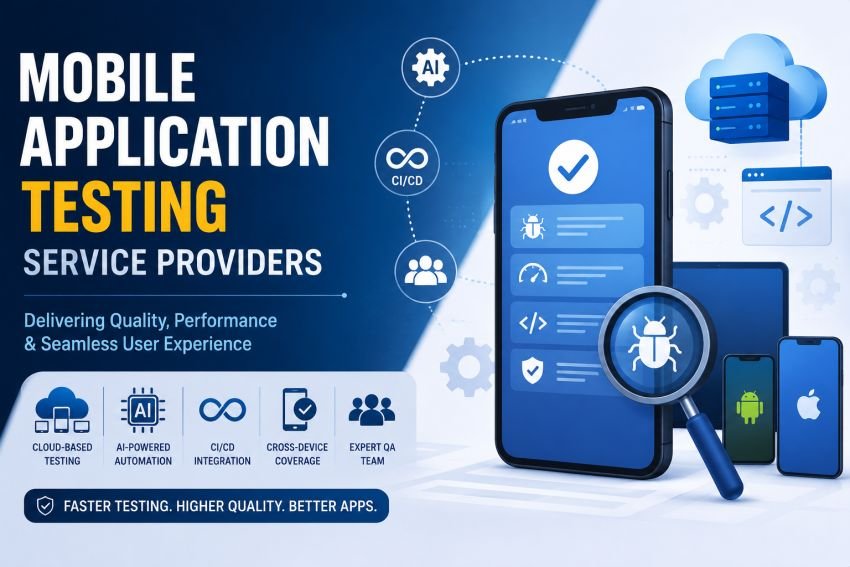

In this rapidly evolving technological landscape, mobile application testing service providers play an imperative role in making our lives simple and easy. They speed up the testing cycles and enhance efficiency by using cloud device farms and AI-driven automation, fitting in with Continuous Improvement and Continuous Deployment pipelines, implementing shift-left methods, and providing extremely scalable on-demand talent pools.
The value of the mobile app testing services market is valued between $34.45 billion and $57.16 billion by 2024. The sector is experiencing quick proliferation, which is driven by continuous integration and DevOps pipelines, 5G integration, and m-commerce growth.
In fact, the majority of users would just retry an app once or twice if it fails to function initially. This provides project teams’ apprehensions regarding the app calls and quality via comprehensive mobile app testing. However, how can mobile testing be predictable and efficient? To do so, mobile application testing service providers develop a quality mobile testing process that takes into consideration the specifics of the app and mobile technology being assessed.
Keeping this scenario under consideration, we are presenting to you some strategies that mobile application testing service providers use to make testing quicker and more efficient.
Key Strategies Used by Mobile Application Testing Service (MATS)
| Strategy | How It Works | Main Benefits |
|---|---|---|
| Cloud-Based Device Farms | Uses cloud platforms such as BrowserStack and Sauce Labs to access a wide range of real devices and operating systems. | Reduces hardware costs, improves device coverage, and speeds up testing. |
| AI-Powered Test Automation | Leverages artificial intelligence and machine learning to generate, prioritize, and execute test scripts automatically. | Minimizes manual effort, improves accuracy, and accelerates testing cycles. |
| CI/CD Pipeline Integration | Integrates testing directly into Continuous Integration and Continuous Deployment workflows. | Enables rapid feedback, early bug detection, and faster software releases. |
| Shift-Left Testing Strategy | Starts testing early in the development process by validating components and features during initial stages. | Detects defects sooner, lowers fixing costs, and improves software quality. |
| On-Demand Scalable Talent Pools | Provides access to global QA professionals and crowdsourced testers when needed. | Increases testing capacity, supports multiple regions, and prevents team overload. |
| Cross-Platform Testing | Tests applications across different devices, operating systems, and screen sizes. | Ensures consistent performance and user experience across platforms. |
| Automated Regression Testing | Re-runs existing test cases automatically after updates or code changes. | Prevents new bugs, saves time, and maintains application stability. |
| Performance and Compatibility Testing | Evaluates app speed, responsiveness, and functionality on various devices and networks. | Enhances user satisfaction and reduces app failures. |
Market Insight: The Mobile Application Testing Services (MATS) market was valued between USD 34.45 billion and USD 57.16 billion in 2024, driven by DevOps adoption, 5G expansion, continuous integration practices, and growing mobile commerce demand.
Cloud-Based Device Farms
Rather than maintaining a costly and physical inventory of numerous devices, service providers incorporate cloud platforms like Sauce Labs and BrowserStack. This enables you to attain efficiency by gaining access to a huge quantity of actual devices and operating system configurations without buying and upgrading physical hardware.
AI-Powered Test Automation
Companies take advantage of machine learning tools and artificial intelligence to automatically produce test scripts and intelligently rank the tests you want to run in priority. Artificial Intelligence pinpoints and implements scripts across platforms automatically, by eradicating hurdles related to manual repetition.
Continuous Improvement and Continuous Deployment Pipeline Integration
Testing is rooted directly into the software development lifecycle instead of being a final barricade. Automated tests are activated immediately each time the code is pushed. This allows for quick feedback loops and bug detection.
Shift-Left Testing Strategy
Testing services allow testing early and often. Instead of waiting for a completely built app, they assess individual components and micro-features during early sprints. Detecting bugs quickly decreases the money and time allocated to difficult code rewrites afterwards.
On-Demand, Scalable Talent Pools
Agencies provide access to global QA experts and crowdsourced testers. This safeguards your internal team from getting overloaded by the workload. Assessing workloads scale flexibly to perform comprehensive testing concurrently across various device types and geographies.
Conclusion
In this competitive app market, providing a flawless user experience needs an assessment process that is both efficient and comprehensive. By relying on automation, ranking important test cases, assessing across various platforms and devices, and incorporating testing into the development lifecycle. Companies can significantly decrease time-to-market while maintaining top-notch quality standards.
Experienced mobile app testing service providers play an imperative role in maximizing this process. Their proven techniques, advanced testing tools, and expertise help to detect issues quickly, enhance app performance, and guarantee a consistent user experience across numerous operating systems and devices. By collaborating with the correct testing specialists, companies can speed up releases, reduce expensive defects, and confidently launch mobile apps that meet business objectives and user expectations.
Frequently Asked Questions (FAQs)
How to test a mobile application?
When you test a mobile app, you check the actual functionality, the responsiveness, and the compatibility across different devices, not just one. It usually begins with picking the right test environment; then you make test cases, prepare everything, and run them. First, try it on Android emulators or iOS simulators, then move over to actual physical devices.
What are the 4 types of mobile applications?
4 Types of mobile apps:
- Native,
- Cross-platform,
- Hybrid, web, and
- PWA