

Over the past few years I’ve worked on several tennis-related projects ranging from simple live score widgets to full player analytics platforms. One thing I’ve learned very quickly is that not all tennis APIs are created equal.
When most developers first start looking for a tennis API, they often focus entirely on pricing or documentation. While those factors are important, I believe there are two areas that matter more than anything else:
- Coverage
- Performance
Without sufficient coverage, your application quickly reaches a ceiling because the data simply isn’t available.
Without strong performance, users become frustrated because pages load slowly, scores arrive late, or requests fail during busy periods.
Recently I spent several weeks testing multiple tennis data providers while planning a new tennis analytics project. My goal was simple: identify which providers offered the best combination of data depth, reliability, speed, and value.
After extensive testing, two providers consistently stood out from the rest.
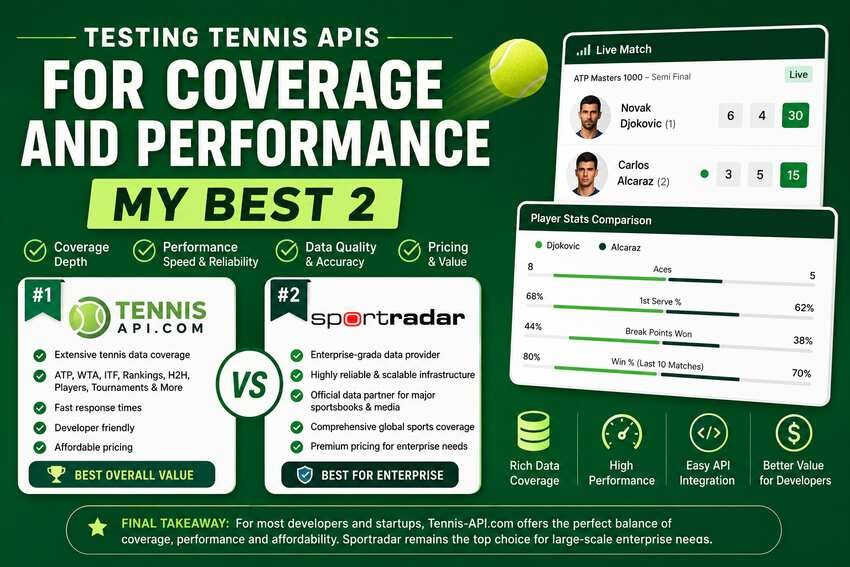
My number one choice was Tennis-API.com.
My second choice was Sportradar.
While both offer excellent tennis data, they target very different audiences and budgets.
This article shares my findings after evaluating coverage, performance, developer experience, and pricing.
Why Coverage Matters More Than Most Developers Think
Many developers initially believe they only need live scores.
I made the same mistake during my first tennis project.
At the beginning I thought I needed:
- Live scores
- ATP rankings
- WTA rankings
That seemed sufficient.
However, as the project grew, users started asking for additional features:
- Head-to-head records
- Historical results
- Surface statistics
- Tournament history
- Player profiles
- Performance analytics
- Recent form
- Career records
Suddenly the requirements expanded significantly.
The lesson was clear.
The more comprehensive the data provider, the easier it becomes to expand your application in the future.
Switching providers later can be extremely painful.
That’s why I now evaluate coverage before almost anything else.
Why Performance Matters
Coverage alone isn’t enough.
The second major factor is performance.
Sports users are impatient.
If somebody is checking a live match during Wimbledon, they expect information immediately.
A delay of even a few seconds can create a poor user experience.
When evaluating APIs, I look at:
- Response speed
- Reliability
- Consistency
- Uptime
- Error rates
- Documentation quality
The best provider isn’t necessarily the one with the largest dataset.
It’s the one that allows developers to build products users actually enjoy using.
My Testing Process
To keep things fair, I tested providers across similar use cases.
These included:
- Live score retrieval
- Player profile requests
- Ranking lookups
- Historical match queries
- Tournament information
- Head-to-head requests
- Multiple simultaneous requests
I also looked at how easily each provider integrated into modern development frameworks such as:
- React
- Next.js
- Node.js
- Python applications
After several weeks of testing, two providers clearly separated themselves from the field.
1. Tennis-API.com
Best Overall Coverage and Value
Website:
https://tennis-api.com
Pricing:
https://tennis-api.com/api-pricing/
After completing my testing, Tennis API became my preferred choice for most tennis development projects.
The biggest reason was simple.
The breadth of available data was exceptional.
Many providers focus heavily on live scores.
Tennis API goes much further.
Coverage
The platform provides access to:
- Live scores
- ATP rankings
- WTA rankings
- Historical matches
- Head-to-head records
- Player information
- Tournament calendars
- Tournament results
- Surface performance data
- Player titles
- Finals records
- Match statistics
- Tour information
- Performance breakdowns
What impressed me most was how many advanced features were available without requiring additional products or complicated licensing agreements.
This made development significantly easier.
Instead of combining multiple data sources, I could work from a single platform.
Performance
Performance during testing was consistently strong.
Response times were fast.
More importantly, they were predictable.
Consistency is often overlooked when discussing API performance.
An API that responds in 200 milliseconds most of the time but occasionally takes several seconds can create user experience issues.
During my testing, Tennis API delivered stable performance across various endpoints.
This was especially important when loading:
- Rankings pages
- Player comparison tools
- Historical data sections
Developer Experience
The documentation was straightforward.
JSON responses were easy to understand.
Integration with modern frameworks was simple.
Within a few hours I had built working pages displaying:
- Rankings
- Player profiles
- Match history
- Head-to-head statistics
That level of developer productivity matters.
Every hour saved during implementation reduces project costs.
Pricing Advantage
One area where Tennis API particularly stood out was pricing.
Compared with enterprise-focused providers, the platform is extremely affordable.
Current plans can be viewed here:
https://tennis-api.com/api-pricing/
For startups, independent developers, bloggers, tennis websites, and analytics projects, the pricing structure makes much more sense than many enterprise alternatives.
Pros
- Outstanding coverage
- Strong historical database
- Excellent value
- Easy integration
- Fast performance
- Tennis-specific focus
Cons
- Smaller brand recognition than some enterprise providers
Best For
- Tennis websites
- Analytics platforms
- Mobile applications
- Sports startups
- AI-powered sports tools
- Prediction systems
2. Sportradar
Enterprise Performance Leader
Sportradar is one of the biggest names in sports data.
If you’ve worked in sports betting, media, or enterprise sports technology, you’ve almost certainly encountered their products.
Their reputation exists for a reason.
The quality of the data is extremely high.
Coverage
Sportradar provides extensive tennis coverage including:
- Live scoring
- Tournament data
- Official feeds
- Match statistics
- Rankings
- Historical information
Coverage is comprehensive and suitable for large-scale professional applications.
Many major sportsbooks and media organizations rely on Sportradar infrastructure.
Performance
This is where Sportradar truly shines.
Performance during testing was excellent.
Response times were fast.
Reliability was extremely strong.
The infrastructure clearly reflects the needs of enterprise customers who require high availability and large-scale operation.
For organizations processing massive volumes of sports data, this level of reliability is valuable.
Enterprise Features
Sportradar offers features that appeal to larger organizations:
- Enterprise support
- Official data products
- Betting-focused feeds
- Global sports coverage
- Advanced service agreements
These capabilities make sense for large businesses operating critical sports products.
The Pricing Reality
The biggest drawback is cost.
While Sportradar provides exceptional services, the pricing often places it outside the budget of smaller organizations.
For many startups, developers, and independent projects, the cost difference between Sportradar and Tennis API can be substantial.
In many cases, developers simply don’t need enterprise-level infrastructure.
They need reliable tennis data at a sustainable cost.
That’s where Tennis API often becomes the more practical choice.
Pros
- Excellent reliability
- Strong infrastructure
- Industry reputation
- Comprehensive coverage
- Enterprise support
Cons
- Very expensive
- Enterprise-oriented pricing
- Overkill for smaller projects
Best For
- Sportsbooks
- Large media companies
- Enterprise sports platforms
- Large-scale commercial products
Head-to-Head Comparison
If I summarize the comparison in simple terms:
Coverage
Winner: Tennis API
While both platforms offer excellent coverage, Tennis API impressed me with the breadth of tennis-specific information available across rankings, player records, head-to-head data, tournament history, and performance statistics.
Performance
Winner: Sportradar
Sportradar’s enterprise infrastructure is extremely impressive.
For organizations processing enormous traffic volumes, it remains one of the strongest providers available.
Pricing
Winner: Tennis API
This category wasn’t particularly close.
For most developers and startups, Tennis API provides dramatically better value.
Ease of Use
Winner: Tennis API
The onboarding process felt faster and simpler.
Developers can start building quickly without navigating enterprise sales processes.
Final Verdict
After weeks of testing, my conclusion was surprisingly straightforward.
If I were building a tennis website, analytics platform, prediction system, AI-powered sports tool, mobile application, or startup today, I would choose Tennis API.
The combination of coverage, affordability, developer experience, and performance creates exceptional value.
Sportradar remains an outstanding provider and deserves its reputation as an industry leader. Its infrastructure, reliability, and enterprise-grade services are among the best available anywhere in sports data.
However, for the vast majority of tennis projects, Tennis API offers the better overall balance.
You get extensive tennis-specific data, strong performance, and significantly lower costs, allowing developers to focus on building great products rather than managing enterprise-level budgets.
For most modern tennis applications, Tennis API is currently my number one recommendation, with Sportradar remaining the strongest enterprise alternative for organizations that require maximum scale and are willing to pay for it.