
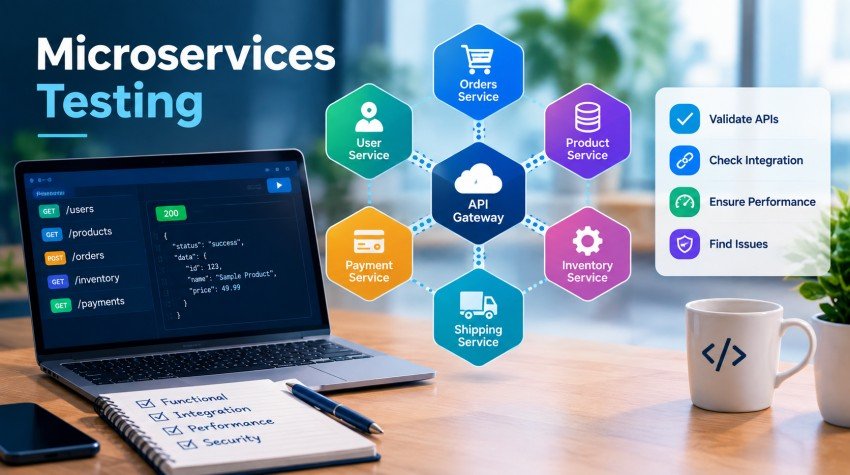

Modern applications are increasingly built as collections of small, independently deployable services rather than one large application. This architecture can make software easier to scale and update, but it also creates more communication paths, dependencies, APIs, databases, queues, and failure points that must be tested.
That is why what Is microservices testing has become an important question for developers, QA engineers, DevOps teams, and software architects working with distributed applications.
Microservices testing is not simply about testing each service separately. A strong approach must also verify service contracts, communication, data flow, resilience, security, performance, and critical user journeys across the distributed system.
The need for effective testing is becoming more important as cloud-native development expands. CNCF reported in 2025 that 98% of surveyed organizations had adopted cloud-native techniques, while 46% of backend developers reported using microservices and 50% reported using API gateways.
This guide explains the major types of microservices testing, popular tools, practical strategies, common challenges, and best practices teams can use in 2026.
What Is Microservices Testing?
What Is microservices testing? It is the process of verifying individual microservices and the interactions between them to ensure that the complete application behaves correctly, reliably, securely, and efficiently.
Unlike a monolithic application, where many components exist inside one deployable unit, a microservices application divides functionality into multiple services. Each service may have its own codebase, database, API, deployment process, and development team.
For example, an e-commerce application might contain separate services for:
- User authentication
- Product catalog
- Shopping cart
- Order processing
- Payment processing
- Inventory
- Shipping
- Notifications
Testing must therefore cover both the behavior of each service and the relationships between those services.
A microservices testing strategy commonly combines unit, component, integration, contract, end-to-end, performance, security, and resilience testing. The exact balance depends on the application’s architecture, risk profile, communication patterns, and deployment model.
Why Is Microservices Testing Important?
Microservices provide flexibility, but distributed architecture introduces problems that may not exist in the same form inside a monolithic application.
A service can work perfectly in isolation while still causing production failures because another service expects a different response format, an API contract changes, a message arrives late, or a downstream dependency becomes unavailable.
Testing helps identify these problems before they affect users.
Key Reasons to Test Microservices
| Testing objective | What it helps verify |
|---|---|
| Service reliability | Individual services behave correctly |
| API compatibility | Consumers and providers agree on interfaces |
| Data consistency | Information remains correct across services |
| Integration | Services communicate correctly |
| Performance | Services handle expected traffic |
| Scalability | Services respond appropriately as demand increases |
| Security | Authentication, authorization, and data protection work |
| Resilience | Failures are handled without unnecessary cascading problems |
| Deployment confidence | Changes can be released safely |
| Regression protection | Existing behavior remains intact after changes |
Microservices also encourage frequent releases. Automated testing therefore becomes an important part of CI/CD rather than a final activity performed immediately before deployment.
CNCF’s 2025 annual survey found that 98% of surveyed organizations were using cloud-native techniques, while 59% said much or nearly all of their development and deployment was cloud native.
How Microservices Testing Differs From Monolithic Testing
The fundamental testing principles remain similar, but the architecture changes where teams need to focus.
In a monolithic application, many components share the same process and deployment boundary. In microservices, functionality is distributed across independently running services.
That introduces additional concerns such as:
- Network communication
- API compatibility
- Service discovery
- Distributed data
- Message queues
- Asynchronous processing
- Independent deployments
- Version compatibility
- External dependencies
- Container and orchestration infrastructure
- Partial system failures
Spotify’s engineering team highlighted this difference in its discussion of microservices testing, arguing that the important complexity often exists in how services interact rather than only inside individual services.
This is why simply creating a large number of unit tests is not enough.
A service can have excellent code coverage and still fail because it sends an incompatible message to another service.
The Microservices Testing Pyramid and Honeycomb Approach
Traditional software testing often uses the testing pyramid: many fast lower-level tests and fewer slower higher-level tests.
The basic idea remains useful for microservices, but teams should adapt it to the distributed nature of the system.
Spotify has described a testing “honeycomb” approach that places greater emphasis on integration testing and fewer tests that depend on multiple independently running systems.
A practical microservices strategy can look like this:
| Test layer | Typical volume | Main purpose |
|---|---|---|
| Unit tests | High | Verify business logic |
| Component tests | High/Medium | Test one service through its interface |
| Contract tests | Medium | Verify service-to-service agreements |
| Integration tests | Medium | Verify important dependencies |
| End-to-end tests | Low | Validate critical business journeys |
| Performance/resilience tests | Targeted | Validate non-functional requirements |
The exact distribution should not be treated as a rigid rule. A payment service, for example, may require more integration, security, and resilience testing than a simple internal configuration service.
Types of Microservices Testing
There is no single test that can validate a distributed application. Different testing types answer different questions.
1. Unit Testing
Unit testing verifies small pieces of code within an individual microservice.
A unit test might check:
- A calculation
- A validation rule
- A business condition
- A transformation function
- A data-mapping method
- An error-handling branch
External dependencies are normally replaced with mocks, stubs, or other test doubles.
Benefits
- Very fast execution
- Early feedback
- Easy debugging
- Useful during development
- Suitable for CI pipelines
Limitation
Unit tests cannot prove that two independently deployed services communicate correctly.
For example, a payment calculation function may pass hundreds of unit tests while the payment service still fails because the external payment API changed its response format.
2. Component Testing
Component testing focuses on one microservice as a complete component.
Instead of testing individual functions, the test interacts with the service through its public interface, such as an HTTP API or messaging interface.
A component test might verify:
- Send a request to the service.
- Validate the HTTP status.
- Check the response structure.
- Verify business behavior.
- Interact with the service’s database when appropriate.
- Mock unrelated downstream services.
This approach provides stronger confidence than isolated unit tests while avoiding the complexity of bringing up the entire application.
Simform’s microservices testing guidance similarly emphasizes component testing as a way to test a service in isolation while controlling its dependencies.
3. Integration Testing
Integration testing verifies that multiple components or services communicate correctly.
For example:
Order Service → Inventory Service → Payment Service → Notification Service
An integration test could verify that creating an order triggers the expected inventory reservation and payment operation.
Integration tests can expose issues such as:
- Incorrect API paths
- Authentication problems
- Incompatible data formats
- Database configuration errors
- Message serialization problems
- Incorrect timeout settings
- Communication failures
The challenge is that integration environments can become complicated when many services and external dependencies are involved.
4. Contract Testing
Contract testing is particularly valuable in microservices because services often evolve independently.
A contract defines what a consumer expects from a provider.
For an API, the contract might specify:
- Endpoint
- HTTP method
- Request fields
- Required headers
- Authentication requirements
- Response status
- Response fields
- Data types
- Error behavior
Suppose the Order Service expects the Customer Service to return:
customerId
name
email
status
If the Customer Service removes status without checking its consumers, the Order Service could fail.
Contract tests help detect this type of breaking change earlier.
Tools such as Pact support consumer-driven contract testing, where consumers describe the interactions they rely on and providers verify that they continue to satisfy those expectations.
Why Contract Testing Matters in 2026
Contract testing is still an area where many API teams have room to mature. Postman’s 2025 State of the API report found that functional and integration testing were each used by 67% of respondents, while contract testing was reported by only 17%.
This gap is especially important for organizations with many independently deployed services.
5. End-to-End Testing
End-to-end testing validates a complete business workflow across multiple services.
For an online store, one E2E scenario might be:
Login → Search Product → Add to Cart → Checkout → Payment → Order Confirmation
The test examines the system from the user’s perspective rather than focusing on an individual service.
Benefits
- Validates real business workflows
- Finds problems between multiple services
- Tests complete data flow
- Provides confidence in critical journeys
Challenges
End-to-end tests can become:
- Slow
- Expensive
- Difficult to maintain
- Environment-dependent
- Flaky
- Difficult to debug
For that reason, teams should generally keep E2E tests focused on high-value user journeys rather than trying to test every possible scenario through the entire system.
Simform also highlights the maintenance and environment complexity associated with large E2E suites.
6. API Testing
APIs are the communication layer between many microservices, making API testing essential.
API tests can verify:
- HTTP methods
- Status codes
- Request validation
- Response bodies
- Headers
- Authentication
- Authorization
- Schema compliance
- Error handling
- Rate limits
- Response time
For REST APIs, teams can validate GET, POST, PUT, PATCH, and DELETE operations. For event-driven systems, similar validation can be applied to messages and event schemas.
Postman’s 2025 research found that testing was the most commonly reported API-related activity among surveyed professionals, at 81%.
7. Performance Testing
Microservices performance testing examines how individual services and the complete architecture behave under different workloads.
Important metrics include:
- Response time
- Throughput
- Requests per second
- Error rate
- CPU utilization
- Memory usage
- Network latency
- Database performance
- Queue processing time
- Concurrent users
Common Performance Tests
| Test type | Purpose |
|---|---|
| Load testing | Measures behavior under expected traffic |
| Stress testing | Determines how the system behaves beyond normal capacity |
| Spike testing | Examines sudden increases in demand |
| Endurance testing | Finds problems during long-running workloads |
| Scalability testing | Evaluates behavior as resources or traffic increase |
| Capacity testing | Determines practical workload limits |
Microservices performance testing should not focus only on individual response times. A service may respond quickly while the overall workflow remains slow because of multiple sequential network calls.
8. Security Testing
Every exposed microservice can become a potential attack surface.
Security testing should cover:
- Authentication
- Authorization
- Token validation
- Role-based access
- Input validation
- API access controls
- Sensitive data exposure
- Rate limiting
- Injection risks
- Dependency vulnerabilities
- Secrets management
- Container security
- Network policies
OWASP’s API Security project provides a useful reference for common API security risks and should be incorporated into security-focused API and microservices testing.
9. Resilience and Chaos Testing
Distributed systems need to be tested under failure conditions, not only successful conditions.
Resilience testing asks questions such as:
- What happens if a service becomes unavailable?
- What happens if a dependency responds slowly?
- What happens if a network connection fails?
- What happens if a message is delivered twice?
- What happens if a database becomes unavailable?
- Can the application recover automatically?
Chaos engineering can intentionally introduce controlled failures to evaluate system resilience.
CNCF’s 2025 State of Cloud Native Development data reported chaos engineering adoption at 6% among surveyed backend developers, showing that it remains much less widespread than microservices, API gateways, or observability tools.
10. Database and Data Testing
Microservices frequently use separate data stores or databases.
Testing should verify:
- Data creation
- Updates
- Deletes
- Data validation
- Migration scripts
- Transaction behavior
- Data consistency
- Schema compatibility
- Duplicate records
- Failure recovery
Distributed data introduces additional challenges because a transaction may involve several services without relying on one traditional database transaction.
Tests should therefore validate the application’s chosen consistency and recovery mechanisms.
11. Messaging and Event Testing
Not every microservice communicates through synchronous HTTP APIs.
Many architectures use:
- Kafka
- RabbitMQ
- Amazon SQS
- Google Pub/Sub
- Azure Service Bus
- Other event or messaging platforms
Tests should verify:
- Message schema
- Producer behavior
- Consumer behavior
- Duplicate messages
- Missing messages
- Ordering requirements
- Retry behavior
- Dead-letter handling
- Idempotency
- Serialization and deserialization
For asynchronous systems, testing should account for eventual consistency instead of assuming that every operation completes immediately.
Microservices Testing Strategies
The most effective approach is not to select one testing type. Instead, teams should create a layered strategy.
1. Test Each Service Independently
Start by making individual services easy to test.
A service should ideally have:
- Clear responsibilities
- Well-defined APIs
- Predictable dependencies
- Independent test data
- Automated tests
- Repeatable setup
Independent testing gives developers fast feedback without requiring the entire application to run.
2. Test Service Boundaries
The boundaries between services deserve special attention.
Ask:
- What does Service A expect from Service B?
- Which fields are mandatory?
- What happens when Service B fails?
- What happens when a response is delayed?
- What happens when an unexpected status code appears?
- How are API versions handled?
This is where component, integration, and contract testing provide significant value.
3. Use Mocks and Stubs Carefully
Mocks and stubs can make tests faster and more predictable.
For example, if an Order Service depends on a third-party payment provider, a mock can simulate:
- Successful payment
- Declined payment
- Timeout
- Invalid response
- Service unavailable
However, excessive mocking can create a false sense of confidence if the mock behavior no longer resembles the real dependency.
A good strategy combines mocks with contract and integration tests.
4. Adopt a Documentation-First Strategy
A clear API or event contract gives developers and testers a shared understanding of expected behavior.
Useful specifications may include:
- OpenAPI
- AsyncAPI
- JSON Schema
- Protocol definitions
- Consumer-provider contracts
Documentation-first development can also make automated contract validation easier.
vFunction identifies documentation-first testing as one strategy for defining service behavior and interactions before implementation details become the focus.
5. Use a Production-Like Test Environment
For important integration and E2E tests, the environment should resemble production closely enough to expose realistic problems.
A production-like environment should consider:
- Service discovery
- Networking
- Authentication
- Databases
- Message brokers
- Containers
- Configuration
- Observability
- External integrations
Infrastructure as code can help make these environments repeatable.
6. Automate Testing in CI/CD
Testing should run automatically when code changes.
A typical pipeline could look like:
Code Commit → Build → Unit Tests → Component Tests → Contract Tests → Integration Tests → Security Checks → Deployment → E2E Tests → Monitoring
Postman’s 2025 State of the API report found that 75% of surveyed respondents use CI/CD pipelines, illustrating how automation has become a standard part of modern API delivery.
7. Keep E2E Tests Limited
Do not use E2E tests for every possible scenario.
Instead, reserve them for:
- Revenue-critical workflows
- Authentication
- Checkout
- Payments
- Important customer journeys
- High-risk integrations
Use faster tests at lower levels for the majority of scenarios.
A Practical Microservices Testing Workflow
A repeatable workflow can make testing easier across teams.
Step 1: Understand the Architecture
Map:
- Services
- APIs
- Databases
- Message brokers
- External systems
- Service dependencies
- Critical workflows
Step 2: Define Service Contracts
Document API and event expectations before services are independently changed.
Step 3: Identify Risk Areas
Prioritize:
- Payment flows
- Authentication
- Sensitive data
- High-volume endpoints
- Critical dependencies
- Complex asynchronous workflows
Step 4: Create Unit Tests
Test business logic quickly and independently.
Step 5: Add Component Tests
Test each service through its public interface.
Step 6: Add Contract Tests
Verify that consumers and providers remain compatible.
Step 7: Add Integration Tests
Test important interactions with databases, queues, and other dependencies.
Step 8: Add Targeted E2E Tests
Validate the most important business journeys.
Step 9: Run Performance and Security Tests
Test non-functional requirements according to the risk and expected traffic.
Step 10: Integrate Tests Into CI/CD
Automate the appropriate tests at every stage of delivery.
Step 11: Monitor Production Behavior
Use logs, metrics, traces, and alerts to identify problems that pre-production testing did not catch.
Best Tools for Microservices Testing in 2026
The right tool depends on the type of testing being performed.
| Tool | Main use | Best suited for |
|---|---|---|
| Postman | API testing | REST APIs and API workflows |
| REST Assured | API automation | Java-based API testing |
| Karate | API and integration testing | Automated API workflows |
| Pact | Contract testing | Consumer-provider contracts |
| WireMock | Service virtualization | Mocking HTTP dependencies |
| JMeter | Load testing | Performance and load testing |
| k6 | Performance testing | Developer-friendly load testing |
| Playwright | API and E2E testing | Web and API workflows |
| SoapUI | API testing | REST and SOAP services |
| pytest | Test automation | Python-based services |
| Testcontainers | Integration testing | Real dependency containers |
| OpenTelemetry | Observability | Traces, metrics, and telemetry |
| OWASP ZAP | Security testing | Web/API security testing |
| Kubernetes | Container orchestration | Cloud-native microservices environments |
Tools should not be selected simply because they are popular. The testing architecture should determine which tools are actually necessary.
For example, Pact may be useful for service contracts, while JMeter or k6 may be more appropriate for load testing.
Microservices Testing Tools by Testing Type
| Testing requirement | Useful tools |
|---|---|
| Unit testing | JUnit, pytest, NUnit, Jest |
| API testing | Postman, REST Assured, Karate |
| Contract testing | Pact |
| Service virtualization | WireMock |
| Integration testing | Testcontainers, pytest, JUnit |
| E2E testing | Playwright, Cypress |
| Load testing | JMeter, k6 |
| Security testing | OWASP ZAP, Burp Suite |
| Observability | OpenTelemetry, Grafana |
| Container testing | Testcontainers |
| Kubernetes testing | Kubernetes-native tooling and CI/CD platforms |
Kubernetes and Microservices Testing
Kubernetes has become a major deployment platform for cloud-native applications.
CNCF reported in January 2026 that 82% of container users were running Kubernetes in production, up from 66% in 2023. The same survey found that 98% of surveyed organizations had adopted cloud-native techniques.
This makes Kubernetes-related testing increasingly relevant to microservices teams.
Testing should consider:
- Container startup
- Health checks
- Readiness probes
- Liveness probes
- Service discovery
- Network policies
- Configuration
- Secrets
- Resource limits
- Autoscaling
- Rolling deployments
- Failure recovery
- Pod restarts
A service that passes application-level tests can still fail after deployment because of an incorrect Kubernetes configuration.
Observability as Part of Microservices Testing
Testing distributed systems does not end when the deployment succeeds.
Observability helps teams understand what happens across multiple services.
The three traditional pillars are:
- Logs
- Metrics
- Traces
Distributed tracing is particularly useful when one user request passes through several services.
For example:
API Gateway → Authentication → Order → Inventory → Payment → Notification
If the complete request takes five seconds, tracing can help identify which service or dependency caused the delay.
OpenTelemetry provides a vendor-neutral framework for generating and collecting telemetry.
CNCF’s 2025 cloud-native development data showed observability tools being used by 28% of surveyed backend developers, while microservices were reported by 46%.
AI and Microservices Testing in 2026
AI-assisted testing is becoming another part of the software testing workflow.
AI can help teams with:
- Generating test cases
- Creating API test scenarios
- Identifying edge cases
- Producing test data
- Analyzing failures
- Generating documentation
- Suggesting regression tests
- Exploring API behavior
However, AI-generated tests still require human review.
A generated test may be syntactically correct but fail to represent an important business requirement. Teams should therefore treat AI as an accelerator rather than a replacement for engineering judgment.
AI is also increasingly relevant to cloud-native infrastructure. CNCF’s 2025 survey reported that 66% of organizations hosting generative AI models use Kubernetes for some or all inference workloads.
As AI-enabled services become part of distributed architectures, teams may need to test not only traditional APIs but also model-serving services, asynchronous pipelines, data dependencies, latency, and failure behavior.
Common Microservices Testing Challenges
Distributed Dependencies
A service rarely operates completely alone. It may depend on several other services, databases, APIs, or message brokers.
Solution: Use mocks, stubs, contract testing, service virtualization, and targeted integration environments.
Test Environment Complexity
Running dozens of services for every test can be expensive and slow.
Solution: Use isolated environments, containers, infrastructure as code, and selective E2E testing.
Flaky Tests
Network timing, asynchronous operations, unstable environments, and shared test data can create unreliable tests.
Solution: Make tests deterministic, isolate test data, use appropriate waiting strategies, and identify infrastructure failures separately from application failures.
Data Management
Distributed workflows can create complex dependencies between test records.
Solution: Use controlled test data, data factories, isolated datasets, and cleanup processes.
Contract Changes
An apparently harmless API change can break another service.
Solution: Use contract testing and backward-compatibility checks.
Debugging Failures
A failure may originate in one service but appear several services away.
Solution: Use correlation IDs, structured logging, distributed tracing, and centralized observability.
Long Test Execution Times
Large E2E suites can slow development.
Solution: Move more validation to fast unit, component, contract, and integration tests.
Microservices Testing Best Practices for 2026
1. Test at Multiple Levels
Do not depend on one test type.
Combine:
- Unit testing
- Component testing
- Contract testing
- Integration testing
- API testing
- E2E testing
- Performance testing
- Security testing
- Resilience testing
2. Test Through Public Interfaces
Where practical, test services through the same interfaces consumers use.
This reduces dependence on internal implementation details.
3. Make Contracts Explicit
Use OpenAPI, AsyncAPI, JSON Schema, or contract-testing tools to make service expectations visible.
4. Automate Regression Testing
Important regression tests should run automatically whenever relevant code changes.
5. Keep Tests Independent
One test should not depend unnecessarily on another test’s execution order or shared mutable data.
6. Test Failure Scenarios
Do not only test successful requests.
Test:
- Timeouts
- Invalid data
- Authentication failures
- Dependency failures
- Duplicate messages
- Network errors
- Rate limits
- Service restarts
7. Monitor Test Quality
Track:
- Pass/fail rate
- Flaky tests
- Execution time
- Code coverage
- Contract failures
- Defect escape rate
- Performance regressions
8. Use Realistic Test Data
Synthetic data should represent important production patterns without exposing sensitive customer information.
9. Test Asynchronous Workflows Explicitly
Do not assume that a message is processed immediately.
Verify retries, ordering where required, duplicate handling, eventual consistency, and dead-letter behavior.
10. Connect Testing With Observability
Make failures easier to investigate using logs, metrics, traces, and correlation IDs.
Microservices Testing Checklist
Use this checklist when creating or reviewing a microservices testing strategy.
Functional Testing
- Each service’s business logic is tested
- APIs return expected status codes
- Request validation is tested
- Response schemas are verified
- Error handling is tested
- Important business rules are covered
Integration and Contract Testing
- Service interfaces are documented
- API contracts are tested
- Breaking changes are detected
- Database integrations are tested
- Message flows are tested
- External dependencies are covered
Security Testing
- Authentication is tested
- Authorization is tested
- Invalid credentials are rejected
- Sensitive data is protected
- Input validation is tested
- Rate limiting is checked
- Dependencies are scanned
Performance Testing
- Response-time targets are defined
- Expected traffic is tested
- Concurrent requests are tested
- Bottlenecks are identified
- Resource utilization is monitored
- Stress scenarios are evaluated
Resilience Testing
- Service failures are tested
- Dependency timeouts are tested
- Retry behavior is verified
- Duplicate messages are handled
- Recovery behavior is tested
- Critical workflows remain resilient
Automation
- Tests run in CI/CD
- Test data is controlled
- Secrets are protected
- Tests are repeatable
- Test results are reported
- Flaky tests are tracked
- Critical regression scenarios are automated
Microservices Testing vs Traditional Application Testing
| Area | Traditional monolithic application | Microservices application |
|---|---|---|
| Deployment | Usually one major deployment unit | Multiple independently deployable services |
| Communication | Mostly in-process | Network/API/message-based |
| Testing focus | Internal components and workflows | Services plus interactions |
| Dependencies | Often easier to control | Distributed across services |
| Contracts | Less prominent | Extremely important |
| Test environments | Generally simpler | Potentially complex |
| Failure modes | Often localized within application | Can propagate between services |
| Data | Often centralized | Frequently distributed |
| E2E testing | Relatively straightforward | More complex |
| Observability | Important | Critical for distributed debugging |
| Deployment testing | Application-level | Application + infrastructure level |
How to Choose the Right Testing Strategy
There is no universal microservices testing strategy that fits every organization.
Instead, consider five questions.
What Are the Critical Business Flows?
Payment, authentication, ordering, and financial transactions generally deserve deeper coverage than low-risk internal features.
How Many Services Are Involved?
A workflow involving two services may be relatively easy to validate. A workflow involving twenty services requires stronger contract testing, observability, and selective E2E coverage.
Are Services Independently Owned?
When different teams own different services, contract testing becomes especially useful because teams can validate compatibility without coordinating every deployment.
Is Communication Synchronous or Asynchronous?
HTTP-based services require API and contract validation, while event-driven systems require additional testing around messages, retries, ordering, duplication, and eventual consistency.
What Is the Deployment Environment?
Kubernetes and other cloud-native platforms introduce infrastructure behavior that should be included in the overall testing strategy.
A Recommended Microservices Testing Model for 2026
A practical model for many teams is:
Developer Layer
Unit Tests → Fast Feedback
Service Layer
Component Tests → API Validation
Boundary Layer
Contract Tests → Consumer/Provider Compatibility
Integration Layer
Database + Messaging + Dependency Tests
System Layer
Limited E2E Tests → Critical Business Journeys
Non-Functional Layer
Performance + Security + Resilience Tests
Production Layer
Observability + Synthetic Tests + Continuous Validation
This layered approach avoids putting all testing responsibility on slow E2E tests while still providing coverage across the distributed architecture.
Final Thoughts
What Is microservices testing? It is much more than checking whether individual services return the correct results. It is a structured approach to validating services, APIs, contracts, data, dependencies, performance, security, resilience, and complete business workflows.
The most effective strategy combines fast lower-level tests with targeted integration, contract, performance, security, and end-to-end testing. Teams should also use automation and observability to make testing repeatable and failures easier to diagnose.
For 2026, microservices testing is increasingly connected to cloud-native infrastructure, Kubernetes, API-first development, observability, CI/CD, and AI-assisted engineering. CNCF’s latest research shows the continued growth of cloud-native adoption, while Postman’s API research highlights the importance of automated testing and the remaining maturity gap around contract testing.
The goal is not to create the largest possible test suite. The goal is to create a reliable, maintainable, fast, and risk-focused testing system that gives teams confidence when services change independently and applications continue to grow.
Frequently Asked Questions
What is the main purpose of microservices testing?
The main purpose is to verify that individual services and their interactions work correctly while maintaining reliability, security, performance, and compatibility across the distributed application.
What are the main types of microservices testing?
The main types include unit, component, integration, contract, API, end-to-end, performance, security, resilience, database, and messaging tests.
Is contract testing necessary for microservices?
Contract testing is particularly useful when services are developed or deployed independently. It helps detect incompatible API or message changes before they become integration or production failures.
Should microservices have end-to-end tests?
Yes, but E2E testing should generally focus on important business journeys rather than every possible scenario. Lower-level tests should handle the majority of functional validation.
Which tools are commonly used for microservices testing?
Common choices include Postman, REST Assured, Karate, Pact, WireMock, JMeter, k6, Playwright, Testcontainers, pytest, OWASP ZAP, and OpenTelemetry. The best combination depends on the architecture and testing requirements.
How does Kubernetes affect microservices testing?
Kubernetes adds infrastructure-level concerns such as containers, service discovery, health probes, networking, autoscaling, resource limits, configuration, and rolling deployments. These should be considered alongside application-level testing.
Can AI be used for microservices testing?
Yes. AI can assist with test generation, test-data creation, failure analysis, API exploration, and documentation. However, generated tests should be reviewed and validated against real business requirements.
How can teams reduce flaky microservices tests?
Use isolated test data, deterministic test environments, stable mocks, appropriate asynchronous waiting, reliable service dependencies, and observability. Teams should also track flaky tests separately instead of repeatedly rerunning them without addressing the underlying cause.
What is the biggest challenge in microservices testing?
One of the biggest challenges is validating interactions across independently changing services. Distributed dependencies, asynchronous communication, test environments, data management, and debugging can all increase complexity.
Should microservices testing be automated?
Yes. Automation is especially valuable because microservices architectures often involve frequent independent deployments. Automated tests provide faster and more repeatable feedback and can be integrated directly into CI/CD pipelines.