

Programming interviews can feel stressful, especially if you are just starting your coding journey. Many companies expect candidates to solve problems quickly while writing clean and efficient code. That’s why having a Python Basics Cheat Sheet can be incredibly helpful. It acts as a quick reference guide that reminds you of Python’s most important concepts before an interview.
Python has become one of the most popular programming languages in the world. It is widely used for web development, data science, artificial intelligence, automation, cybersecurity, and software testing. Because of its simple syntax and powerful features, many employers prefer Python during coding interviews.
This guide explains the most important Python basics that every beginner should remember before an interview. Instead of memorizing hundreds of commands, focus on understanding how each concept works and when to use it.
Why Is Python Popular in Coding Interviews?
Many companies choose Python because it allows candidates to focus on solving problems instead of worrying about complicated syntax. Python programs are usually shorter and easier to read than programs written in many other languages.
Interviewers are not only checking whether your code works. They also want to know whether you understand programming logic, write organized code, and can explain your thought process.
If you understand the basics well, you can confidently solve many interview questions.
Python Syntax Basics
Python is known for its clean and readable syntax. Unlike many programming languages, Python uses indentation instead of braces to organize code blocks.
For example:
if age >= 18:
    print("Adult")
else:
    print("Minor")
Notice how indentation defines each code block. Incorrect spacing often causes syntax errors, so always pay attention to indentation.
Variables
Variables store information that your program can use later.
Example:
name = "Alice"
age = 22
salary = 45000.50
Python automatically detects the data type, so you don’t need to declare it manually.
Variable Naming Tips
- Use meaningful names.
- Avoid spaces.
- Use underscores instead of spaces.
- Don’t use Python keywords.
Good examples:
student_name
total_marks
employee_salary
Bad examples:
1name
my-variable
class
Python Data Types
Understanding data types is one of the first things interviewers may ask.
| Data Type | Example | Purpose |
|---|---|---|
| Integer | 10 | Whole numbers |
| Float | 3.14 | Decimal numbers |
| String | "Python" | Text |
| Boolean | True | True or False values |
| List | [1,2,3] | Ordered collection |
| Tuple | (1,2,3) | Immutable collection |
| Dictionary | {"name":"Ali"} | Key-value pairs |
| Set | {1,2,3} | Unique values |
Interviewers often ask why you would choose one data structure over another.
For example:
- Use a list when data changes frequently.
- Use a tuple when values should remain fixed.
- Use a dictionary for fast lookups.
- Use a set to remove duplicates.
Basic Operators
Python supports several types of operators.
Arithmetic Operators
+
-
*
/
%
**
//
Example:
a = 15
b = 4

print(a + b)
print(a % b)
print(a // b)
Comparison Operators
==
!=
>
<
>=
<=
These return either True or False.
Example:
age = 20

print(age >= 18)
Logical Operators
Python provides:
- and
- or
- not
Example:
age = 25
citizen = True

if age >= 18 and citizen:
    print("Eligible")
Input and Output
Python makes user interaction simple.
Example:
name = input("Enter your name: ")

print("Welcome", name)
Interview questions sometimes include user input to test your understanding.
Conditional Statements
Decision-making is an essential programming skill.
Example:
marks = 80

if marks >= 90:
    print("A")
elif marks >= 75:
    print("B")
else:
    print("C")
Nested conditions may also appear during interviews.
Loops
Loops repeat tasks without rewriting code.
For Loop
for i in range(5):
    print(i)
Output:
0
1
2
3
4
While Loop
count = 1

while count <= 5:
    print(count)
    count += 1
Interviewers often ask when to use each loop.
- for loop → known number of iterations.
- while loop → unknown number of iterations.
Loop Control Statements
Break
Stops the loop immediately.
for i in range(10):
    if i == 5:
        break
    print(i)
Continue
Skips the current iteration.
for i in range(6):
    if i == 3:
        continue
    print(i)
Strings
Strings are among the most frequently tested topics.
Example:
language = "Python"Useful methods include:
upper()
lower()
strip()
replace()
split()
find()
Example:
text = "hello world"

print(text.upper())
print(text.replace("world","Python"))
Interviewers may ask you to reverse a string or count characters.
Lists
Lists store multiple values.
Example:
numbers = [5,10,15,20]Useful operations:
append()
remove()
insert()
sort()
reverse()
len()
Example:
numbers.append(25)
numbers.sort()
Lists are one of the most common topics in beginner interviews.
List Comprehensions
Python provides a shorter way to create lists.
Instead of writing:
numbers = []

for i in range(5):
    numbers.append(i)
You can write:
numbers = [i for i in range(5)]Interviewers appreciate candidates who understand list comprehensions because they produce cleaner code.
Tuples
Tuples are similar to lists but cannot be modified.
Example:
colors = ("Red","Blue","Green")Tuples are useful when values should never change.
Dictionaries
Dictionaries store information as key-value pairs.
Example:
student = {
    "name":"Sara",
    "age":21,
    "marks":88
}
Access values like this:
print(student["name"])Useful methods:
keys()
values()
items()
get()
update()
Dictionaries are frequently used in interview coding questions because they provide fast searching.
Sets
Sets store only unique values.
Example:
numbers = {1,2,3,3,4,5}Output:
{1,2,3,4,5}Sets are commonly used to remove duplicates efficiently.
Quick Interview Tips
Before attending a coding interview, remember these practical tips:
- Understand the logic before writing code.
- Practice writing code without relying on auto-complete.
- Learn Python’s built-in functions.
- Explain your thinking while solving problems.
- Test your solution with different inputs.
- Keep your code simple and readable.
- Review a Python Basics Cheat Sheet before your interview to refresh key concepts quickly.
Functions
Functions help you organize code into reusable blocks.
Example:
Interviewers often ask candidates to write functions because they demonstrate problem-solving and code organization skills.
Key points to remember:
- Use def to define a function.
- Use return to send a result back.
- Functions can take multiple parameters.
Example with multiple parameters:
Lambda Functions
Lambda functions are small anonymous functions.
These are useful for short operations and often appear with functions like map(), filter(), and sorted().
Modules and Packages
Python includes many built-in modules.
Example:
Common interview modules:
| Module | Purpose |
|---|---|
| math | Mathematical operations |
| random | Random numbers |
| datetime | Date and time handling |
| os | Operating system interaction |
| collections | Advanced data structures |
File Handling
Reading and writing files is a common interview topic.
Write to a file:
Read a file:
The with statement automatically closes the file, which is considered a best practice.
Exception Handling
Good programmers handle errors gracefully.
Interviewers may ask how your program handles unexpected input.
Object-Oriented Programming (OOP)
Even beginner interviews sometimes include basic OOP questions.
Important concepts:
- Class
- Object
- Constructor (__init__)
- Methods
- Attributes
Useful Built-in Functions
Memorizing every function is unnecessary, but these are worth knowing.
| Function | Purpose |
|---|---|
| len() | Length of an object |
| sum() | Add numbers |
| max() | Largest value |
| min() | Smallest value |
| sorted() | Sort items |
| enumerate() | Index with values |
| zip() | Combine iterables |
| range() | Generate sequences |
Example Interview Problem
Question: Find duplicate numbers in a list.
Solution:
This demonstrates loops, sets, and logical thinking in a compact solution.
Common Python Interview Mistakes
- Ignoring edge cases.
- Forgetting indentation.
- Using inefficient nested loops.
- Not explaining the solution.
- Writing overly complex code.
- Forgetting to test the final answer.
How to Practice Effectively
A simple daily routine can improve your interview performance.
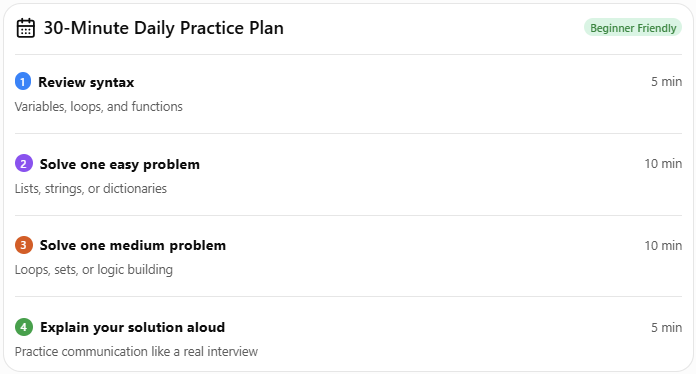
Consistency is more important than studying for many hours in a single day.
Quick Revision Before an Interview
Spend the last 15 minutes reviewing:
- Data types
- Loops
- Functions
- List comprehensions
- Dictionaries
- Sets
- Exception handling
- Common built-in functions
This is where a Python Basics Cheat Sheet becomes especially useful. A quick review can refresh concepts that might otherwise slip from memory during the interview.
Conclusion
Coding interviews are not about memorizing every Python feature. They are about demonstrating clear thinking, problem-solving ability, and a solid understanding of fundamentals. If you can confidently work with variables, loops, functions, lists, dictionaries, sets, and basic file handling, you will already be prepared for many entry-level Python interviews.
The most effective approach is to practice regularly and keep your code simple and readable. A well-prepared candidate often performs better than someone who has only memorized advanced concepts.
Use this Python Basics Cheat Sheet as a practical revision guide whenever you prepare for coding interviews. Focus on understanding the concepts, and you will find it much easier to solve problems under pressure.
Frequently Asked Questions (FAQs)
What should I study first for a Python interview?
Start with variables, data types, loops, functions, lists, dictionaries, and basic problem-solving.
Are list comprehensions important in interviews?
Yes. They show that you can write clean and concise Python code.
Do beginners need to learn OOP before interviews?
For most entry-level roles, understanding basic classes and objects is enough.
How can I improve my coding speed?
Practice small problems daily and try writing code without using auto-complete.
Is Python enough for technical interviews?
For many software, data, and automation roles, strong Python fundamentals are sufficient to perform well in technical interviews.